 63/100
Bisto ‘Aah Nights’: how a 1919 catchphrase became a night of the week
McCann Erickson took the Bisto Kids' hundred-year-old 'Aah' and turned it into a booked appointment. A review of the Bisto advert that sold an occasion, not gravy.
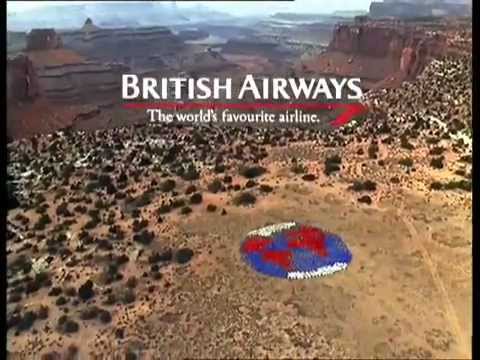

One of the most beautifully executed pieces of British television advertising and a real lesson in making an abstract claim visible, scored down on effectiveness because no published evidence links it to a commercial result.
An airline commercial with no aeroplane in it should not work. British Airways ran one for ninety two seconds in 1989, spent over a million pounds on it, and ended up with the most imitated aerial shot in advertising. Saatchi & Saatchi wrote it, Hugh Hudson directed it, and the pay off is a human face assembled out of crowds in the Utah desert, which then smiles, winks and turns into the planet. Our take: it is a scale trick in service of a genuinely simple thought, and the thought is what has kept it alive.
Everything in the film is people. There is no cabin, no meal service, no legroom and no fare. British Airways is selling the fact that it moves human beings towards each other, and it makes that abstract claim physically visible.
British Airways had been privatised in 1987 and was trading on the line “the world’s favourite airline”, a claim about passenger volume rather than about service. Volume is a difficult thing to make attractive. Told plainly, “we carry more people than anyone else” sounds like a boast about crowding, which is the one association an airline does not want.
The category answer at the time was product advertising: seats, cabins, cutlery, smiling crew. That route was closed to a flag carrier trying to speak to seventy countries at once, because the product proof varies by route and the crew shot dates instantly. Saatchi & Saatchi went the other way and turned the volume claim into the idea itself.
The reframe is in the voice over. Twenty four million passengers a year is not a statistic about capacity, it is a statistic about reunion. Once you accept that, the commercial writes itself: show the people, not the aircraft.
Crowds in red walk out of the sea and resolve, from above, into a pair of lips. A crowd in blue and black moves through a city and becomes an eye. A crowd in white crosses grassland and becomes an ear. The parts converge on a salt flat and form a face that smiles, winks and becomes the globe.
It is one sentence of strategy given a body. The audience is asked to hold two scales at once, the individual walking and the collective shape, and the switch between them is the entire emotional payload. Nothing is explained, because the aerial reveal explains it.
The one line of copy arrives late and does almost nothing decorative. “Every year, the world’s favourite airline brings 24 million people together.” Tom Conti reads it flat, over the reveal, and then the film stops. A lesser version would have added a benefit, a destination list or a smiling passenger, and every one of those additions would have shrunk the picture.
Hugh Hudson had made Chariots of Fire and Greystoke, and he shoots this as a film rather than as a spectacle reel. The ground level shots come first and they are deliberately ordinary: feet, faces, people walking with purpose. Only then does the camera climb, so the reveal feels earned rather than announced.
The logistics are the craft here. Production ran across Utah, including Salt Lake City, Lake Powell and the salt flats near Moab, with thousands of extras who had to hold formation while an aircraft flew the shot. Judy Chabola, who had arranged the crowd movements at the 1984 Los Angeles Olympics, choreographed the sequences, and Nostalgia Central puts the cast at 4,000 American high school students. Getting a wink out of a crowd that size is a rehearsal problem, not a camera problem.
The music does the emotional lifting. “Aria” by Yanni and Malcolm McLaren adapts the Flower Duet from Leo Delibes’ 1883 opera Lakme, and the choice is smarter than it looks. Opera signals occasion without signalling a country, so the film can play in seventy markets without sounding like it belongs to one of them. It also gave British Airways an audio asset it used long after this film retired, which very few advertisers of the period managed.
Colour is the last piece of discipline. Red, white and blue are on screen constantly, in swimwear and shirts and the Union Jack in the background, so the nationality is delivered without a word of flag waving. The brand is in the palette rather than in the script.
This is the weakest part of the case, and we mark it honestly. The reliably documented figures are about production and reach rather than about revenue: a budget of over a million pounds and an audience of more than 600 million people in 70 countries. No published effectiveness paper attributes a share, revenue or yield movement at British Airways to this commercial.
What the film demonstrably did was fix the meaning of a claim. “The world’s favourite airline” ran for years afterwards and this is the piece of work that made it feel warm rather than statistical. That is a real job, and it is also a job that resists measurement thirty seven years later.
The public record it does have is longevity in the polls. It sits at number 62 in Channel 4’s The 100 Greatest TV Ads in 2000, and it climbed to number 15 in ITV’s Best Ads Ever in 2005. Rising up a list five years after the last one is unusual, and it suggests the film survived on its own terms rather than on nostalgia for the airline.
Face became a format. Hudson returned for the Island commercials from the mid nineties, in which helicopters stretch coloured sheets across an island until it reads as a map of the world, which is the same trick at a different scale. Hotpoint parodied the original in 1994 with crowds forming socks and underwear, and in 2007 Hudson parodied his own film for Silverjet, using the same locations and the same aria.
Being parodied twice by other advertisers is a better fame metric than most tracking studies. It means the visual grammar entered the language: the ground level tease, the vertical pull back, the crowd resolving into a symbol. Drone footage has since made the technique cheap, which is precisely why so much of it now feels empty. The shot only means something when the crowd is the argument.
It also belongs to a specific British moment, when big budget television craft was the main competitive weapon a brand had. Guinness spent the following decades proving the same point with a different kind of spectacle. Both sit comfortably in our ranking of the best advertising campaigns.
One of the most beautifully executed pieces of British television advertising, and a genuine lesson in making an abstract claim visible, scored down only on effectiveness because no published evidence links it to a commercial result and the surviving numbers describe the budget and the audience rather than the business. Our marking is explained in how we score.

He plans, buys and reviews advertising for a living, and helps score campaigns on the site against the same five Crown Score criteria alongside other authors and contributors.
63/100McCann Erickson took the Bisto Kids' hundred-year-old 'Aah' and turned it into a booked appointment. A review of the Bisto advert that sold an occasion, not gravy.
 73/100
One photograph of Heinz Beanz on two biscuits, no paid media, a day of brand replies and a debate in the House of Commons. Frank PR's Beanz on Bix, reviewed.
 79/100
BMP DDB gave the jokes to Rowan Atkinson and the product line to his assistant. Seventeen films, nine British Arrows, an IPA Gold and a cinema franchise later, a full review.