Snickers has run one line, “You’re not you when you’re hungry”, in more than 80 countries since Super Bowl Sunday in February 2010. Pepsi ran one film, the Kendall Jenner protest spot, for less than 48 hours in April 2017. Both were made by capable people with serious budgets. The gap between them is what the Crown Score exists to measure.
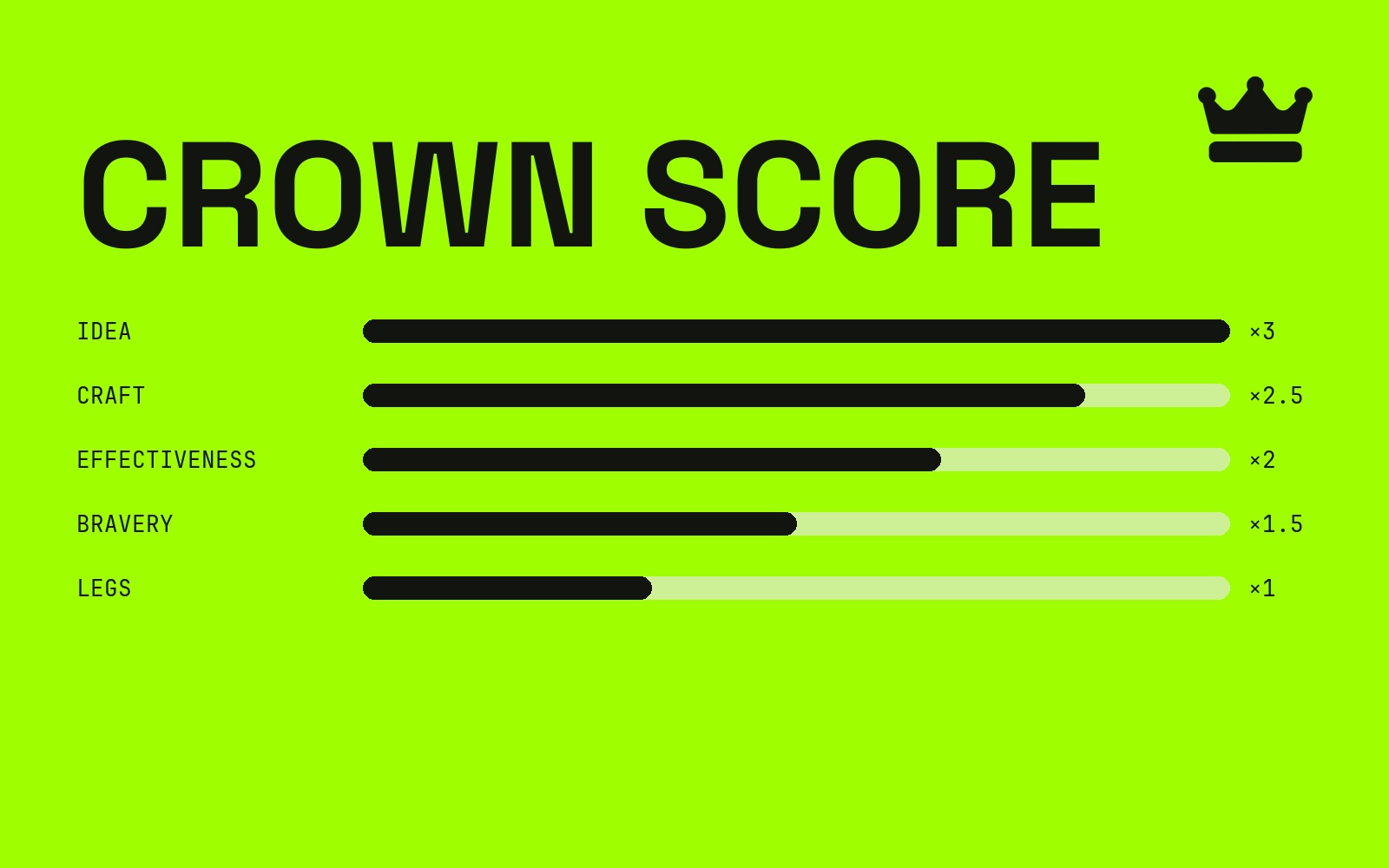
Every campaign reviewed on Ad Ranking is marked against the same five criteria, weighted by how much each one matters to whether an advert works. Idea carries 30 points, Craft 25, Effectiveness 20, Bravery 15 and Legs 10. Each criterion is scored from 0 to 10, multiplied by its weight, and the total is the Crown Score out of 100.
The weights are an argument. An idea outweighs its execution because a strong idea survives an average film, while a beautiful film cannot rescue an empty one. Effectiveness outranks bravery because moving a number is the point. Legs carries the least because longevity depends partly on the client’s nerve.
Idea (30 points): one sharp thought a stranger could repeat
The test is simple. Could someone who saw the ad once tell a friend what it was about in a sentence, and would the friend get it? “Hunger turns you into someone else” passes. “A celebration of togetherness” does not, because it describes a mood rather than a thought.
Snickers scores high. BBDO New York launched “You’re not you when you’re hungry” at Super Bowl XLIV in February 2010 with Betty White being tackled into the mud. The thought was portable enough to travel to dozens of markets with local casting and the same joke. The IPA case study, which won Gold at the 2012 Effectiveness Awards, records a 15.9 per cent global sales increase in one year and share gains in 56 of the 58 markets where it ran.
Pepsi scores low. The 2017 “Live for Now” film, made in-house by the company’s Creators League Studio, showed Kendall Jenner leaving a photoshoot to hand a can to a police officer at a protest. Asked what the idea was, Pepsi’s own statement offered “a global message of unity, peace and understanding”, then withdrew the ad on 5 April 2017, as ABC News reported. A message is not an idea. There was nothing for a stranger to repeat except the outrage.
Craft (25 points): direction, writing, casting, sound, design
Craft is the discipline of making every decision serve the idea. We look at direction, writing, casting, sound and design, and a high score needs all five pulling the same way, not one brilliant element carrying four ordinary ones.
Guinness “Surfer” is the benchmark. Written by Tom Carty and art directed by Walter Campbell at AMV BBDO, directed by Jonathan Glazer and first aired on 17 March 1999, it turned the wait for a pint into a surfer waiting for a wave, with white horses breaking through the foam to Leftfield’s “Phat Planet”. In 2000 a Channel 4 and Sunday Times poll voted it the best advert of all time, a verdict Creative Salon upheld on its 25th anniversary. Every element argues for the line “Good things come to those who wait”.
Peloton “The Gift That Gives Back” is craft that is technically competent and tonally deaf. Mekanism’s 2019 Christmas spot was well shot, but the casting of an already slim woman, the writing of her nervous video diary and the framing of a husband gifting his wife an exercise bike read to many viewers as coercion. CBS News recorded a 9 per cent fall in Peloton’s share price on 3 December 2019. Craft is not polish. Craft is judgement.
Bravery (15 points): did the brand risk something?
Bravery is not the same as controversy. It is the willingness to make an ad that could fail in public, and then to stand behind it. We score the risk taken and the resolve shown, because a brand that flinches converts its bravery into damage.
Nike “Dream Crazy” scores high. Wieden+Kennedy Portland put Colin Kaepernick, the quarterback who knelt during the national anthem, at the centre of the 30th anniversary of “Just Do It” in September 2018. Nike did not apologise, and NBC News reported Edison Trends data showing online sales up 31 per cent over the Labor Day weekend that followed. The film won the Outdoor Grand Prix at Cannes Lions in 2019.
Bud Light scores low. In April 2023 the brand sent a commemorative can to the transgender influencer Dylan Mulvaney, who posted it to Instagram. Anheuser-Busch neither defended nor explained the partnership, and its chief executive Michel Doukeris said customers wanted to enjoy their beer “without a debate”. CBS News reported sales down 26.5 per cent in the month to 15 July 2023, with Modelo Especial taking the title of America’s best-selling beer. Taking a risk and then retreating from it is the least brave option of all.
Effectiveness (20 points): verified evidence it moved a number
We only count evidence we can check. Awards, views and press coverage are not results. Sales, share, penetration, price premium, enquiries or a change in behaviour, published with enough rigour to rule out other explanations, are.
Our standard is set by the IPA Effectiveness Awards, which since 1980 have required entrants to prove commercial payback and rule out other causes. Les Binet and Peter Field’s “The Long and the Short of It” (IPA, 2013) found that emotional campaigns produce larger long-term business effects than rational ones, and that budgets split roughly 60:40 between brand building and activation perform best. System1’s Star Rating, which predicts long-term share growth from emotional response, is our leading indicator when hard results are not yet published. Byron Sharp’s “How Brands Grow” (2010) supplies the language of mental availability: an advert works if it makes the brand easier to think of when the buying moment arrives.
John Lewis scores a 10. The “Making the nation cry… and buy” paper by adam&eveDDB and Manning Gottlieb OMD won the 2012 IPA Grand Prix by demonstrating £1,074 million of incremental sales and £261 million of incremental profit in just over two years from mid 2009.
Dumb Ways to Die scores low here, despite McCann Melbourne’s Metro Trains campaign winning a record five Grand Prix at Cannes in 2013. Metro claimed a fall in near-miss incidents of between 20 and 30 per cent in the months after the November 2012 launch. The figures were never independently verified, the campaign failed to medal in Creative Effectiveness at Cannes, and Mumbrella asked in print whether it had changed behaviour at all. A brilliant idea with an unproven result stays unproven on our scorecard.
Legs (10 points): can it run for years and across formats?
Legs is the question of whether the idea is a platform or a stunt. Can it produce a fifth year as good as its first? Does it work as a six-sheet, a radio spot and a TikTok without the seams showing?
Compare the Market scores a 10. VCCP launched Aleksandr Orlov on 5 January 2009 to solve a search problem: the word “market” was expensive to bid on, and “meerkat” was not. The site rose from the 16th to the 4th most visited insurance website in Britain, and seventeen years later the campaign is still on air.
Burger King’s “Moldy Whopper” scores low by design. Ingo Stockholm, David Miami and Publicis filmed a burger decaying over 34 days in February 2020 to prove the removal of artificial preservatives, and Creative Review recorded three Grand Prix at Epica 2020 alongside a D&AD Black Pencil. It is a magnificent one-off. You cannot rot a burger twice, and nobody has tried.
How the scale works
Each criterion runs from 0 to 10, and we mark hard. A 5 is competent work that does its job without anyone remembering it. A 7 is a good advert that the trade press would cover. An 8 is the best work of the year in its category.
A 9 or 10 is reserved for canonical work: an ad that changed how the industry thinks, or a result that changed how the client’s board thinks. “Surfer” is a 10 for craft. Snickers is a 10 for idea. John Lewis is a 10 for effectiveness.
The arithmetic is then plain. A campaign scoring Idea 8, Craft 7, Bravery 6, Effectiveness 5 and Legs 7 earns 24, 17.5, 9, 10 and 7 points, a Crown Score of 67.5, which we round to 68. Anything above 85 is Ad Royalty. Anything below 40 is a caution to the rest of the industry.
Scores are provisional, and we say so
Effectiveness evidence arrives late, often two or three years after launch, and quarterly results take time to separate the ad from price and distribution. So every Effectiveness mark published before hard evidence exists is flagged as provisional, and we revisit it when a case study, a results statement or an independent analysis appears. If Dumb Ways to Die ever publishes audited behaviour data, its score moves. If a campaign we admired turns out to have coincided with a price cut, its score moves the other way.
How to judge an advert of your own: the checklist
You do not need our scorecard to use our method. Before the work leaves the building, ask these questions and answer them honestly.
- Idea: Write the idea in one sentence with no adjectives and read it to someone outside marketing. If they cannot repeat it back, you have a mood, not an idea.
- Idea: Could a competitor run this with their logo swapped in? If yes, the idea belongs to the category, not to you.
- Craft: List the five decisions (direction, writing, casting, sound, design) and say what each one is doing for the idea. Anything there only because it looks good is dead weight.
- Craft: Show it to the audience it depicts before you show it to the audience it targets.
- Bravery: Name the thing that could go wrong, then write down in advance what the brand will say if it does. If the answer is “apologise and pull it”, do not run it.
- Effectiveness: Agree the number the ad is supposed to move before the shoot, and how you will know the ad moved it rather than the promotion running alongside. If you cannot describe the counterfactual, you cannot claim the result.
- Legs: Sketch the third execution before you make the first. If you cannot think of it, you have a stunt.
- Legs: Check the idea survives with the sound off and on a bus shelter. Aleksandr Orlov does.
Score your own work out of 100 on those weights and be tough. If it comes out under 60, the industry would say the same, only later and in public.