The best Halloween adverts ever made, ranked
Twelve Halloween adverts ranked on idea, craft, bravery and evidence, from Burger King's Scary Clown Night and Tesco's Spookermarket to Heinz Tomato Blood, with verified credits.
From Guinness Surfer to Barbie, Ad Ranking counts down the 50 best advertising campaigns of all time, with verified agency credits, dates and results.
A surfer waits for a wave, a gorilla waits for a drum fill, and a man in a launderette waits for his jeans. The best advertising campaigns are mostly about tension and release, and the fifty below are the ones a working marketer is expected to know cold: the reference points in every pitch, every planning deck and every argument about whether an idea is really an idea.
The criteria are simple. Did the work carry one sharp thought a stranger could repeat? Did it move a number the brand was willing to publish? Did it change how the industry worked afterwards? Global work sits alongside British work because the British canon is, on this evidence, as strong as anyone’s. Every credit and year has been checked; where a claim could not be verified it has been left out.
D’Arcy Masius Benton & Bowles wrote the line in 1994 and Skittles has never needed another. It is a product truth, a colour palette and a permission slip for weirdness, which is why TBWAChiatDay New York could later hang films about a man who turns everything he touches into sweets on it. Crown verdict: a four-word platform that has outlived several agencies and every fad.
Nestlé launched the positioning on 1 April 2002 with a wrapper flash and £3 million of TV and print built on one provocative joke. It drew 97 complaints to the ASA in its first year, none upheld, and two city councils banned a men-only sampling stunt. The line ran until 2011. Crown verdict: proof a chocolate bar can own a stance, and a warning about how fast a stance dates.
Warner Bros spent an estimated $150 million on promotion, more than the film’s $145 million production budget, while Mattel coordinated well over a hundred brand partnerships from Airbnb to Xbox. The colour did the work: a pink billboard with a date on it needed no logo. The film took $1.448 billion worldwide. Crown verdict: the modern template for turning a release date into a season.
Lego’s first global brand campaign in three decades came from BETC Paris and the in-house Lego Agency, with a Traktor-directed film in which a hunter chases a rabbit through a world that obeys minifigure physics. The bricks only appear at the end. Crown verdict: a toy brand talking about creativity without a single child at a table, which is harder than it looks.
Euro RSCG cast Jonathan Goldsmith as a silver-bearded adventurer who “doesn’t always drink beer” and gave an import a personality bigger than its distribution. Dos Equis reported US sales up 22 per cent while other imported beers fell 4 per cent, and revived Goldsmith in January 2026. Crown verdict: the last great print-style character to be born on television.
Two white cups on a mall table, one Pepsi and one Coke, and a camera on the drinker’s face. The blind taste test began in 1975, turned a comparison into a decade of Cola Wars and rattled Coca-Cola into New Coke. Malcolm Gladwell later noted sweeter drinks win sips, not cans. Crown verdict: the original challenger stunt, and still the one every challenger copies.
Dancer Fitzgerald Sample put Clara Peller in front of a bun the size of a hubcap and let Joe Sedelmaier direct her fury. Within weeks Walter Mondale was using the line against Gary Hart in the Democratic primaries. Crown verdict: three words that escaped the ad and entered the language, the rarest result in the business.
Crispin Porter + Bogusky and Spike Jonze made you grieve for a desk lamp left in the rain, then had a Swede tell you off: “It has no feelings, and the new one is much better.” It took the Cannes Film Grand Prix and a Grand Clio in 2003. Crown verdict: the cleanest demonstration of building an emotion in order to puncture it.
CAA Marketing and Johnny Kelly at Nexus built a stop-motion farm that industrialises and repents, to Willie Nelson singing Coldplay’s The Scientist. Meant for cinemas and online, it ended up running in full during the Grammys and won the Cannes Film Grand Prix in 2012. Crown verdict: branded content before the term became an excuse.
On Black Friday 2011 Patagonia took a full page in the New York Times to tell readers not to buy its R2 fleece, itemising the 36 gallons of water and 20 pounds of carbon dioxide behind it. Sales rose around 30 per cent in the months after. Crown verdict: the paradox every purpose campaign since has tried and mostly failed to repeat.
McCann Manchester’s Clive Davis and Andy Fenton pitched a 3p carrot as the hero of a Christmas table, narrated by Jim Broadbent. Ten years on Kevin has been married off and the ads have scored five stars in System1 testing for six straight years. Crown verdict: the best long-running British brand character this century, built from the cheapest thing in the store.
Lowe Howard-Spink wrote the line in 1993 and gave it a face in 1995 with Dotty, Prunella Scales’s impossible mother, across 25 films. The IPA case credits the early work with 1.3 million new customers by 1995 and it took the Effectiveness Grand Prix in 2000. Crown verdict: a slogan that doubles as an operating principle, which is why it has outlasted every agency.
BMP DDB’s Andy McLeod and Richard Flintham discovered they disagreed about the spread and built a strategy on the argument in October 1996. Admitting half the country hates you is confident for a yeast extract, and it gave the language a word: the “Marmite” film or politician. Crown verdict: the bravest positioning here, because it wrote off half the market on purpose.
Trevor Beattie at TBWA London put Eva Herzigová on a 48-sheet looking down at herself with a two-word caption, and the legend about distracted drivers followed within weeks. The poster later hung in the V&A and placed tenth in a Poster of the Century poll. Crown verdict: the peak of the 1990s British poster boom, and a reminder that outdoor rewards one joke told once.
For Just Do It’s thirtieth anniversary, Wieden+Kennedy Portland put Colin Kaepernick’s face under the line “Believe in something. Even if it means sacrificing everything.” The #BoycottNike backlash was immediate; so was the recognition that Nike had chosen its customer and accepted the cost. Crown verdict: the clearest recent case of a brand taking a side and pricing the risk in advance.
Rethink Toronto asked people in 18 countries to draw ketchup without naming a brand, and 97 per cent drew a Heinz bottle. The sketches became posters, press ads and, briefly, real labels. It won a Gold Print Lion in 2022 and Heinz reported a 10 per cent sales lift. Crown verdict: brand tracking turned into the creative itself.
FCB New York geofenced McDonald’s restaurants across the United States and offered a one-cent Whopper to anyone who opened the Burger King app while standing in a rival’s car park. The mechanic was the media plan, the download was the conversion and the trolling was the PR. Crown verdict: the template for using a competitor’s estate as your own point of sale.
McCann New York placed Kristen Visbal’s bronze girl in front of Wall Street’s Charging Bull on 7 March 2017. It won 18 Cannes Lions that June, four of them Grand Prix; State Street then paid $5 million to settle pay discrimination charges covering around 300 women. Crown verdict: the most awarded idea of its decade, and the most instructive about the gap between message and employer.
Forsman & Bodenfors and director Andreas Nilsson stood Jean-Claude Van Damme between two reversing lorries to Enya’s Only Time, and a dynamic steering demo reached 40 million views in nine days. It took the Cannes Creative Effectiveness Grand Prix in 2015. Crown verdict: a B2B feature made into the most watched film of its year, which should shame every dull trade ad since.
Ogilvy in Australia replaced the most famous logo in the world with first names. The agency estimated the campaign lifted Coke’s category share by 4 per cent and young adult consumption by 7 per cent, and it has since run in more than 80 countries. Crown verdict: personalisation before CRM software hijacked the word, done on the pack rather than in an email.
Nobody planned it, no agency owns it, and it raised more than $100 million for the ALS Association in the summer of 2014, with $220 million reported worldwide. Funds helped identify the NEK1 gene’s link to the disease in 2016; a 2015 relaunch raised about $1 million. Crown verdict: the purest viral mechanic on record, and proof that you cannot schedule one.
On 14 October 2012 Felix Baumgartner stepped out of a capsule 39 kilometres above New Mexico and broke the sound barrier in freefall. YouTube counted more than 9.5 million concurrent viewers, then a live-stream record. There is no product in shot at any point. Crown verdict: the moment an energy drink proved it was a media owner.
TBWA’s first ad for Carillon Importers put a halo over a plain Swedish bottle, and the campaign ran for more than 25 years across art, cities and fashion, always the same silhouette. Absolut entered the American Marketing Association’s Hall of Fame in 1992 alongside Coca-Cola and Nike. Crown verdict: the definitive lesson in making the pack the idea and never letting go.
Goodby Silverstein & Partners launched on 29 October 1993 with Aaron Burr, a Michael Bay film about a history buff who cannot answer a $10,000 phone-in because his mouth is full of peanut butter. Deprivation, not benefit, was the strategy, and awareness passed 90 per cent. Crown verdict: the best example of selling a commodity by showing life without it.
Charles Stone III’s short film True, friends bellowing down the phone, became a Budweiser campaign after DDB Chicago’s Vinny Warren pitched it; the first spot aired on 20 December 1999. It won the Cannes Grand Prix, a Grand Clio and a scene in Scary Movie. Crown verdict: the last catchphrase campaign of the pre-social era, and it would have gone viral in any other.
Saatchi & Saatchi and Hugh Hudson choreographed thousands of extras into an eye, an ear and a smiling face seen from the air, under the “world’s favourite airline” line. It ran in more than 80 countries for close to a decade. Crown verdict: the high-water mark of the 1980s epic, when a British airline could advertise like a nation.
Collett Dickenson Pearce built a 30-year campaign on one structure: a small humiliation, a lit cigar, and Jacques Loussier’s jazz reading of Bach’s Air on the G String. Gregor Fisher’s photo booth, in which the chair collapses on the third attempt, is the best remembered. Cinema ads ended in 1999 ahead of the tobacco ban. Crown verdict: consistency as craft, decades before anyone said “platform”.
Boase Massimi Pollitt’s tin robots laughing at humans who peel, boil and mash their own potatoes made a Cadbury convenience product a household name. Campaign called it the TV ad of the century, and the 2000 Sunday Times and Channel 4 poll ranked it second only to Surfer. Crown verdict: the funniest product demonstration ever filmed, because it mocks the customer and gets away with it.
HHCL’s portly orange man slapping a drinker while two commentators replay the hit was so copied in playgrounds that the agency reshot it with a kiss. It ranked third in the 100 Greatest TV Ads poll of 2000 and did for HHCL what Launderette did for BBH. Crown verdict: the moment British advertising found it could be loud, stupid and brilliant at once.
Graham Daldry wrote the line in-house in 2002 and it has run since 2003, from a shepherd shearing his sheepdog to a whole print campaign of near-misses. Specsavers Creative grew from six people to more than 80 on the back of it. Crown verdict: Britain’s strongest argument for an in-house agency, and a punchline the public completes for free.
VCCP launched Aleksandr Orlov on 5 January 2009, an aristocratic Russian meerkat furious that people confused his website with a price comparison site. Simon Greenall’s uncredited voice and “simples” did the rest; the site became the UK’s fourth most visited insurance destination. Crown verdict: an expensive search term solved by a character rather than a bigger budget.
AMV BBDO and David Abbott set white Helvetica on the magazine’s red and wrote lines that flattered the reader for getting them: “I never read The Economist. Management trainee. Aged 42.” No image, no logo beyond the colour, and a format any writer could pick up. Crown verdict: the most imitated poster campaign in British history, and still the standard for copy that respects intelligence.
Fallon London released 250,000 bouncing balls down a San Francisco hill, Nicolai Fuglsig shot them in slow motion and José González’s Heartbeats made it feel like a hymn. “Colour like no other” needed no more explanation, and it won a Gold Lion in 2006. Crown verdict: the film that made every electronics brand want a spectacle and gave few of them the taste to pull it off.
Leo Burnett and documentary maker Lauren Greenfield asked adults and then young girls to run “like a girl”, and the gap between the answers was the film. It launched in June 2014, re-ran at Super Bowl XLIX and took the Cannes Grand Prix, the Titanium Lion and an Emmy in 2015. Crown verdict: a sanitary towel brand reframing an insult, and the best social experiment the format has produced.
BBDO New York opened with Betty White being tackled in a muddy park game at the 2010 Super Bowl, and the mechanic, a hungry person becomes someone else until they eat, has translated into every market since. BBDO credits it with taking Snickers from seventh to first among American bars. Crown verdict: the best global platform of the century so far, because any country can cast it.
Doyle Dane Bernbach’s Paula Green wrote it and Helmut Krone laid it out: “Avis is only No. 2 in rent a cars. So why go with us? We try harder.” Admitting second place was the whole brand for fifty years, until Avis retired the line in 2012. Crown verdict: the founding document of challenger marketing, and a copy lesson in turning a weakness into a promise.
Frances Gerety at N. W. Ayer & Son wrote four words in 1947 that tied an uncommonly hard stone to an uncommonly long commitment, and invented the modern engagement ring market in the process. Advertising Age named it the best slogan of the twentieth century in 2000. Crown verdict: the most commercially consequential line ever written, whatever you think of the category.
Leo Burnett took a filtered brand sold to women and gave it a cowboy in 1954, without a word about the filter. Sales went from around 18 million cigarettes a year to 6 billion by 1955, and Marlboro became America’s best seller in 1972. Several of the men who played him died of smoking-related disease. Crown verdict: the most effective image in advertising history, and the most uncomfortable.
McCann Melbourne’s John Mescall wrote a nursery rhyme about bears, toasters and train tracks, Julian Frost animated it and Ollie McGill scored it, and a rail safety message became a global earworm in November 2012. It took five Grand Prix and 18 Gold Lions at Cannes 2013, still a record, and Metro reported near-misses down about 20 per cent. Crown verdict: the only safety campaign anyone can sing.
Bartle Bogle Hegarty put Nick Kamen in a 1950s launderette, took his 501s off to Marvin Gaye’s I Heard It Through the Grapevine, and sold more than 2 million pairs of boxer shorts in a year as a side effect. It ranked sixth in the 100 Greatest TV Ads poll of 2000. Crown verdict: the film that made British advertising cool, and the start of a Levi’s run that put seven songs to number one.
TBWAChiatDay’s Rob Siltanen, Craig Tanimoto and Lee Clow greeted Steve Jobs’s return with a black-and-white roll call of Einstein, Gandhi and Picasso and a script beginning “Here’s to the crazy ones.” Richard Dreyfuss narrated; Jobs recorded a version and shelved it. It won the 1998 Emmy and the 2000 Grand Effie. Crown verdict: a manifesto that rebuilt a company’s self-belief before it had the products to justify it.
Wieden+Kennedy Portland and Tom Kuntz moved Isaiah Mustafa from bathroom to boat to horse in one take, aimed at the women who buy men’s body wash. Then the agency answered fans with personalised video replies, and by July 2010 the films held eight of YouTube’s top eleven spots. It won the Cannes Film Grand Prix and an Emmy. Crown verdict: the first campaign to treat social media as live performance rather than distribution.
Ogilvy’s Düsseldorf and London offices put women who were not models on posters in Germany and Britain, photographed by Rankin, and let the public argue. Evolution, the 2006 time-lapse of a face retouched into a billboard, won two Cannes Grand Prix, and Ad Age reports Dove sales rose from $2 billion to $4 billion in three years. Crown verdict: the campaign that made purpose commercially respectable, and started every argument about it.
Dougal Wilson’s film for adam&eve follows a small boy counting down to Christmas, apparently for his presents, and reveals he wanted to give one. Slow Moving Millie’s cover of The Smiths’ Please, Please, Please, Let Me Get What I Want set the template for a decade of festive cover versions. Crown verdict: the ad that made a department store’s Christmas film a national event, and the one every rival still measures against.
Wieden+Kennedy London and Antoine Bardou-Jacquet built a two-minute chain reaction from the parts of an Accord, shot in around 100 takes on a £1 million production budget, and aired it in full only a handful of times from 6 April 2003. Honda’s UK site became the second most visited automotive site overnight and sales rose 28 per cent. Crown verdict: the last great analogue spectacular, made just before everyone assumed such things were CGI.
Helmut Krone’s tiny Beetle in a field of white space and Julian Koenig’s plain-spoken copy for Doyle Dane Bernbach sold a small German car to a country that wanted fins. Advertising Age named it the best campaign of the twentieth century in 1999, and the layout, honesty and wit are still the grammar of print. Crown verdict: the ad that invented the creative team, and the one every art director copies without knowing it.
Dan Wieden took the line from Gary Gilmore’s last words, “Let’s do it”, and put it at the end of a 1988 film about veteran San Francisco runner Walt Stack. Over the next decade Nike’s share of the North American sports shoe market rose from 18 to 43 per cent and worldwide sales from $877 million to $9.2 billion. Crown verdict: three words that made a shoe company the world’s authority on effort.
Juan Cabral at Fallon London wrote and directed a gorilla waiting for the drum fill in Phil Collins’s In the Air Tonight, with no chocolate in shot and only “a glass and a half full of joy” at the end. It launched on 31 August 2007 during the Big Brother final, after a salmonella recall, and Cadbury nearly did not run it. Dairy Milk sales rose 9 per cent and it took the Cannes Film Grand Prix in 2008. Crown verdict: the film that proved feeling beats message, and the reason a decade of briefs asked for “joy”.
Chiat/Day’s Steve Hayden, Brent Thomas and Lee Clow hired Ridley Scott to have an athlete hurl a sledgehammer through Big Brother’s screen, and the film ran nationally once, during Super Bowl XVIII on 22 January 1984. Around $3.5 million of Macintoshes sold in the days after, and it went on to the Cannes Grand Prix, the Clio Hall of Fame and TV Guide’s top spot in 1999. Crown verdict: sixty seconds that launched a product, a rivalry and an annual ritual.
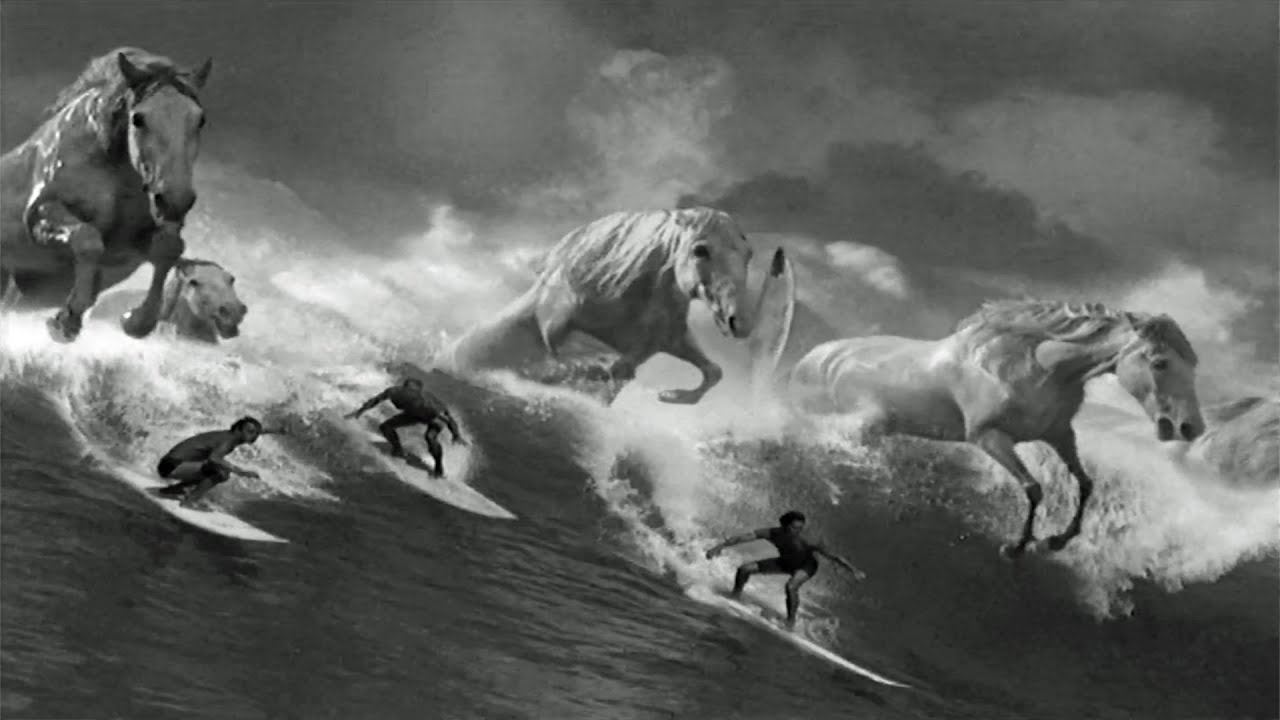
Walter Campbell and Tom Carty at AMV BBDO, under David Abbott, turned “good things come to those who wait” into a Polynesian surfer facing a wave that becomes white horses. Jonathan Glazer directed through Academy and the Computer Film Company built the horses. It first aired on 17 March 1999 and won more awards than any commercial that year. In 2000 the Sunday Times and Channel 4 poll named it the greatest TV ad ever made, ahead of Smash and Tango. Crown verdict: the best minute of advertising film ever produced, and the product’s slowest pour is the whole idea.
Each campaign was scored on the sharpness of the idea, verified commercial effect, influence on the work that followed, and whether it still holds up today. Idea and influence weighed heaviest, which is why Think Small sits above campaigns with bigger reported sales lifts and why Surfer, a single film, tops platforms that ran for decades. Where brands or agencies published numbers we used and attributed them; where they did not, we did not guess. Arguments about the order are welcome, and are the point.

He plans, buys and reviews advertising for a living, and helps score campaigns on the site against the same five Crown Score criteria alongside other authors and contributors.
Twelve Halloween adverts ranked on idea, craft, bravery and evidence, from Burger King's Scary Clown Night and Tesco's Spookermarket to Heinz Tomato Blood, with verified credits.
Twenty food adverts ranked on idea, craft, bravery and evidence, from the Gold Blend couple and Coca-Cola's Hilltop to Jaffa Cakes, PG Tips and Maltesers, with verified credits.
Fifteen beer adverts ranked on idea, craft, bravery and evidence, from Heineken's Refreshes the Parts and Carling's Dambusters to Dos Equis and Corona, with verified credits.