 63/100
Bisto ‘Aah Nights’: how a 1919 catchphrase became a night of the week
McCann Erickson took the Bisto Kids' hundred-year-old 'Aah' and turned it into a booked appointment. A review of the Bisto advert that sold an occasion, not gravy.
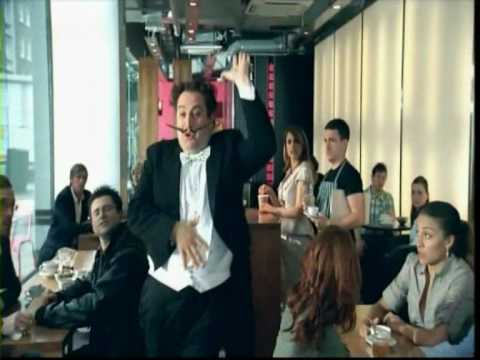

Cheap to look at, impossible to forget, and backed by a commercial turnaround its own creator is happy to put numbers on: the strongest case in British advertising that likeability is optional.
A Welsh tenor stands in a coffee shop in a costume borrowed from a provincial opera house and bellows a jingle set to a First World War recruiting song. Britain voted the campaign the most irritating advertising on television two years running. It also, on the account of the man who wrote it, took GoCompare from a £4m loss to a £12m profit inside a year. The Gio Compario campaign is the strongest argument in British advertising that being liked and being effective are separate jobs.
The one-line take: a deliberately annoying idea, executed with more discipline than anyone gives it credit for, that bought a fourth-place brand a permanent seat at the table.
By 2009 price comparison was the noisiest category on British television and GoCompare was not winning it. Comparethemarket had already bought itself a talking animal, Confused.com had scale, and Moneysupermarket had a head start. Campaign’s own write-up of the first Gio film noted the obvious: GoCompare had “followed its rival Comparethemarket by introducing a memorable character”. The task was not to be admired. It was to be the name that surfaced when somebody’s renewal letter landed.
That is a memory problem, not a persuasion problem. Every comparison site offers the same thing in the same way, so the differentiator is which brand name arrives first in the head. Wilkins and Vickers, working in-house rather than through an agency, decided to solve it with a jingle rather than an argument. The brand name would not be mentioned in the ad. It would be the ad.
The construction is almost mathematical. Take the brand name, which is two stressed syllables and a hard consonant, and hang it on the most emphatic melody in the popular songbook. Wilkins has said the team went back to another wartime call to action, “Over There”, and found an Enrico Caruso recording of it, which is where the operatic tenor came from. Sing the URL to that tune and the listener has memorised it whether or not they consented.
The film itself is one shot of an idea. Gio interrupts an ordinary British moment, holds an operatic note far longer than the room can bear, and leaves. There is no demonstration, no comparison table, no price. The only piece of information is the name, delivered four times.
The character is a piece of deliberate misdirection too. Gio Compario is written as an Italian tenor and played by Wynne Evans, a Welshman from Carmarthen who trained at the Guildhall and the National Opera Studio. The joke is that the operatic apparatus, the tails, the moustache, the held high note, is being spent on car insurance. That gap between the grandeur of the form and the banality of the message is the whole gag, and it is why the campaign survived seventeen years of variations.
It is fashionable to say there is no craft here. That is wrong, it is just that all the craft is in the audio. The lyric has to land the domain name cleanly on the strongest beats, survive being sung by a heavy operatic voice, and still be re-writable for every new execution, which Wilkins and Vickers did repeatedly across the run.
Evans is the other half of it. He is a genuine tenor, not a comedian doing an impression of one, and the performance only works because the singing is technically real while the situation is absurd. He signed a six-album deal with Warner in 2010 off the back of the campaign and his first album went to number one in the UK classical chart. Very few brand mascots have a recording career as a side effect.
The visual language, by contrast, is deliberately unremarkable: bright, flat, over-lit, closer to a shopping channel than a car ad. That is a choice, not a failure. It keeps the audio in the foreground and it signals low cost, which in a category built on saving money is the correct posture. Compare it with the picture-making in Cadbury’s Gorilla and you are looking at two opposite theories of what a television commercial is for.
Start with the hatred, because it is unusually well documented. In Marketing’s annual TNS poll, GoCompare was named the most irritating advertising in the UK for a second year running, cited by 56% of respondents in 2009 and 59% in 2010, comfortably ahead of Webuyanycar.com on 48%. Six years later, research by J Walter Thompson for ITV’s sixtieth anniversary voted Gio the ad the nation most loves to hate, with MoneySuperMarket’s “Epic strut” second and Cillit Bang third.
Now the money. Wilkins has given the clearest published account of the commercial effect, and it is not hedged.
Yes, it was voted Most Annoying Campaign in the marketing press for two years running. But, to put this in context, the year before the campaign broke Go Compare posted a loss of £4m. At the end of the campaign’s first year, they posted a profit of £12m.
Chris Wilkins, interviewed by Asbury & Asbury
GoCompare’s founder Hayley Parsons has said the campaign lifted brand awareness by 450% in the second half of 2009, with turnover up 53% across the year. Those are company-reported figures rather than an independently audited effectiveness case, and we score them accordingly. But the direction of travel is not in dispute, and neither is the endpoint: YouGov data cited by The Drum in 2024 put Go.Compare’s fame score at 92% against a popularity score of 53%.
In 2012 the brand did the only thing left to do with an irritant: it agreed with the audience. Dare’s “Saving the nation” campaign had Sue Barker, Stuart Pearce, Jimmy Carr, Ray Mears, Louie Spence and Stephen Hawking take turns trying to kill Gio. Nick Hall, then head of marketing, said the point out loud: “We know a lot of people find the character irritating and this is us saying ‘we get it’.”
It worked as provocation. The Stuart Pearce execution drew 1,008 complaints and the Sue Barker rocket launcher film drew 797, making GoCompare the most complained about advertiser of 2012. The ASA upheld neither, finding the films light-hearted, fantastical and unlikely to cause harm.
The rulings that did go against GoCompare were about numbers, not noise. In February 2016 the ASA upheld a complaint from Confused.com about the “Gio’s Return” television ad, which claimed “over 40 million customers” without excluding duplicate accounts, and told GoCompare not to run it again in that form. The accompanying poster claim was cleared. In April 2018 an animated ad featuring a money-eating monster was given a 7.30pm scheduling restriction after a complaint that a young child had copied it. Neither ruling touched the singing.
The campaign has outlasted three agency arrangements. Dare won the £28m account in February 2012, ending the in-house Wilkins and Vickers relationship, and the pair were later brought back for the 2015 “Gio returns” work. Droga5 London took the account in 2019 and produced “Tree”, which drew 336 complaints and became the most complained about advertisement of that year, again without being upheld.
Then the brand did something more interesting than another stunt. In 2024, working with the branding agency Ragged Edge, Go.Compare demoted Gio from star to watermark, keeping him as a recognition device across the experience while the advertising moved on to expertise. Marketing director Paul Rogers framed the category problem neatly: “Price comparison is one of those categories where everybody does broadly the same thing and you are all shouting quite loudly to get attention.” The asset was too valuable to kill and too abrasive to keep at full volume, so they turned it down.
Gio Compario is not good advertising by the standards creative departments use on each other, and it was never trying to be, which is why it keeps embarrassing work that is. The idea is one sentence long, the execution is cheap on purpose, and the commercial evidence, though company-reported rather than independently audited, points one way. Judged as craft it belongs nowhere near the top of our all-time list. Judged as a solution to the actual brief, which was to make a fourth-place brand unforgettable in a category nobody thinks about, it is close to unimprovable, and you can read how we weigh those against each other in our scoring method.

He plans, buys and reviews advertising for a living, and helps score campaigns on the site against the same five Crown Score criteria alongside other authors and contributors.
63/100McCann Erickson took the Bisto Kids' hundred-year-old 'Aah' and turned it into a booked appointment. A review of the Bisto advert that sold an occasion, not gravy.
 73/100
One photograph of Heinz Beanz on two biscuits, no paid media, a day of brand replies and a debate in the House of Commons. Frank PR's Beanz on Bix, reviewed.
 79/100
BMP DDB gave the jokes to Rowan Atkinson and the product line to his assistant. Seventeen films, nine British Arrows, an IPA Gold and a cinema franchise later, a full review.