 63/100
Bisto ‘Aah Nights’: how a 1919 catchphrase became a night of the week
McCann Erickson took the Bisto Kids' hundred-year-old 'Aah' and turned it into a booked appointment. A review of the Bisto advert that sold an occasion, not gravy.
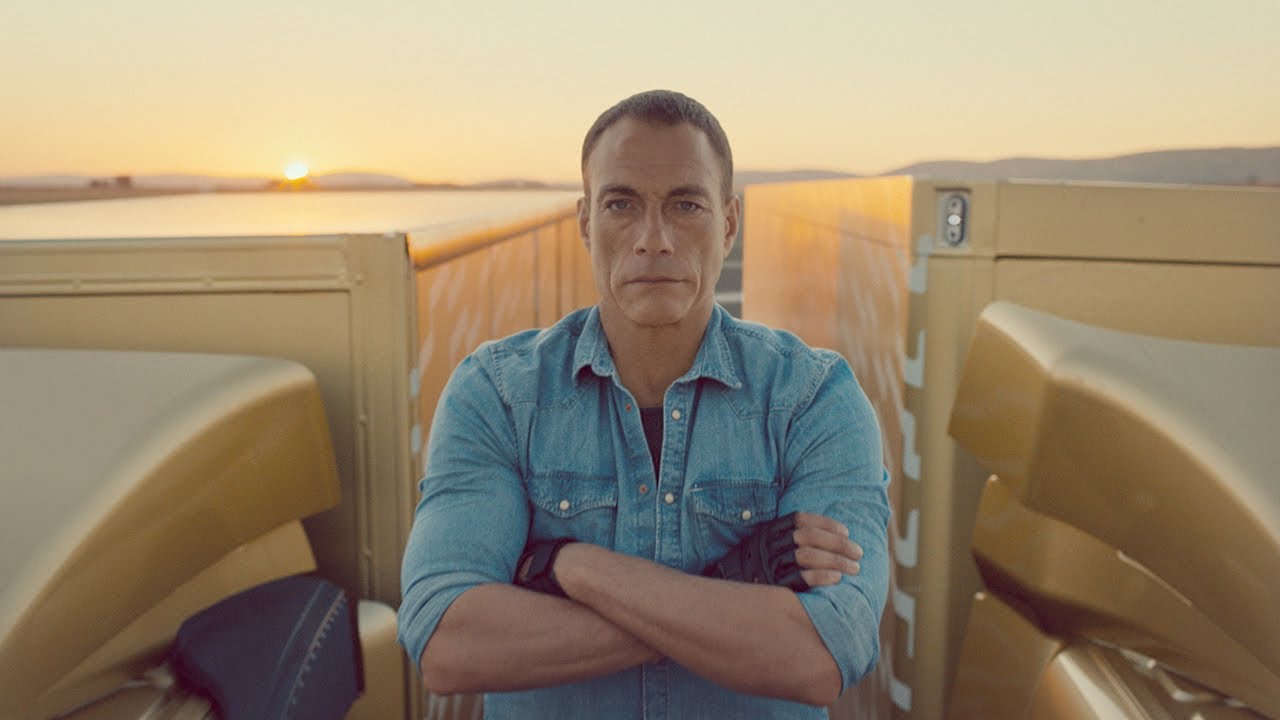

A steering demonstration that happens to be beautiful, and the only truck advert with three points of market share and a Cannes Creative Effectiveness Grand Prix behind it.
Two Volvo FM tractor units reverse down an empty runway at sunrise. Jean-Claude Van Damme stands with one boot on each wing mirror, arms lifted, and lets his legs open until he is holding a full side split between two moving trucks. Enya sings. Nobody speaks until the final seconds, when a caption explains that the point of all this is the precision of a steering system.
Our take: “The Epic Split” is the most expensive-looking product demonstration ever committed to film, and it is still, structurally, a product demonstration. That is why it won a Cannes Creative Effectiveness Grand Prix rather than just a shelf of film metal.
Volvo Trucks had five new models to put into market at once, The commercial objective was blunt: grow market share by selling more trucks. The communications objective was to make people aware of Volvo Trucks and the new range, which is harder than it sounds when your buyers are a few thousand fleet managers and owner-drivers spread across dozens of countries.
Business-to-business advertising usually solves this with trade press, dealer events and a brochure full of torque figures. Forsman & Bodenfors solved it by ignoring the media plan that the category expects. The Live Test series was built for YouTube first, on the assumption that a truck film interesting enough for a non-buyer would eventually reach every buyer, because buyers are also people with phones.
Each Live Test takes one engineering claim and stages it as a stunt with real consequences. In “The Hook”, the president of Volvo Trucks, Claes Nilsson, stood on the front of a Volvo FMX while it was hoisted more than 20 metres above Gothenburg harbour by its own towing hook, a component rated to hold 32 tonnes. “The Epic Split” was the sixth in the run, and its claim was Volvo Dynamic Steering, a system that takes the wobble out of a heavy vehicle at low speed.
The proof had to be something a viewer could not fake in their head. Two trucks reversing in perfect parallel lines, with a man’s body as the measuring instrument, is a test that visibly fails if the steering drifts by a few centimetres. It is the same logic as Volkswagen’s “Think Small”: state the product truth so plainly that the audience does the persuading.
Andreas Nilsson shot the film at the disused Ciudad Real airport in Spain, at sunrise, for the flat low light that lets you read the horizon behind the trucks. The team rehearsed for three days before the take that made the edit. The camera was an Arri Alexa on a boom arm mounted to a chase vehicle, holding a single unbroken move as the two trucks reverse at 25 kilometres per hour, as fxguide documented at the time.
Van Damme was 53 when the film was released, and the split is his. Concealed platform supports and safety rigging carried some of the load, with the wires painted out afterwards by Swiss International and the grade handled by The Mill. That is honest film-making rather than a cheat: the stunt still requires a man to hold a full split, unsupported at the hips, while two 40-tonne vehicles move underneath him.
The sound design is the decision most people underrate. Choosing Enya’s “Only Time” over a rock cue removes every trace of the truck advert’s usual masculinity and replaces it with something closer to a hymn. It also gives Van Damme’s short spoken monologue the space to sound sincere rather than ridiculous.
The single take matters commercially, not just artistically. A cut would have invited the accusation that the whole thing was assembled in post, and the entire persuasive weight of a Live Test rests on the audience believing the test happened.
The film took 6.5 million views on its first day and passed 40 million inside nine days, with roughly 32,000 shares and a tripling of Volvo Trucks’ YouTube subscriber base, according to The Drum. Volvo Trucks’ own upload now stands at more than 128 million views. Those are large numbers for a product almost nobody watching can buy, which is exactly why they are not the proof.
The proof is what the agency reported afterwards. Half of viewers said they were more interested in buying a Volvo truck after seeing the Live Test series, and two thirds of that group took an action, either visiting the website or contacting a dealer. Volvo Trucks grew market share by three percentage points during the campaign period despite raising prices. Fourth-quarter sales in 2013 rose 24 per cent, making it the company’s best year to that point.
The industry agreed. The Live Test series took the Creative Effectiveness Grand Prix at Cannes Lions in 2015, a category judged on evidence rather than craft. Before that it had collected a D&AD Black Pencil in 2014, Best in Show at The One Club and the Film Grand Prix at Eurobest. Very little advertising wins both the film juries and the effectiveness juries, and our scoring method weights that double proof heavily.
Within weeks the internet had produced parody splits featuring Chuck Norris between two aircraft, Channing Tatum and the then mayor of Toronto. Parody is the clearest available evidence that a piece of work has entered general culture rather than advertising culture. Enya’s “Only Time”, released in 2000, re-entered the Billboard Hot 100 at number 43 on the back of it, as the Chicago Reader noted at the time.
The deeper legacy is a permission structure. Before 2013, business-to-business marketing in heavy industry was largely a rational-benefit exercise with a small budget and a trade media plan. After 2013, a truck manufacturer had a Cannes effectiveness Grand Prix, and every industrial marketer had a case study to wave at a sceptical board. It sits in our list of the best advertising campaigns for that reason as much as for the stunt.
“The Epic Split” earns its reputation because it is not a stunt film that happens to carry a logo, it is a steering demonstration that happens to be beautiful, and the discipline of that distinction is what separates it from a decade of imitators who bought the spectacle and forgot the product. Three points of market share against a price rise, in a category where a single sale runs to six figures, is the rarest kind of evidence in advertising. The one deduction is longevity: the Live Tests eventually ran out of escalations, and no sequel has come close.

He plans, buys and reviews advertising for a living, and helps score campaigns on the site against the same five Crown Score criteria alongside other authors and contributors.
63/100McCann Erickson took the Bisto Kids' hundred-year-old 'Aah' and turned it into a booked appointment. A review of the Bisto advert that sold an occasion, not gravy.
 73/100
One photograph of Heinz Beanz on two biscuits, no paid media, a day of brand replies and a debate in the House of Commons. Frank PR's Beanz on Bix, reviewed.
 79/100
BMP DDB gave the jokes to Rowan Atkinson and the product line to his assistant. Seventeen films, nine British Arrows, an IPA Gold and a cinema franchise later, a full review.