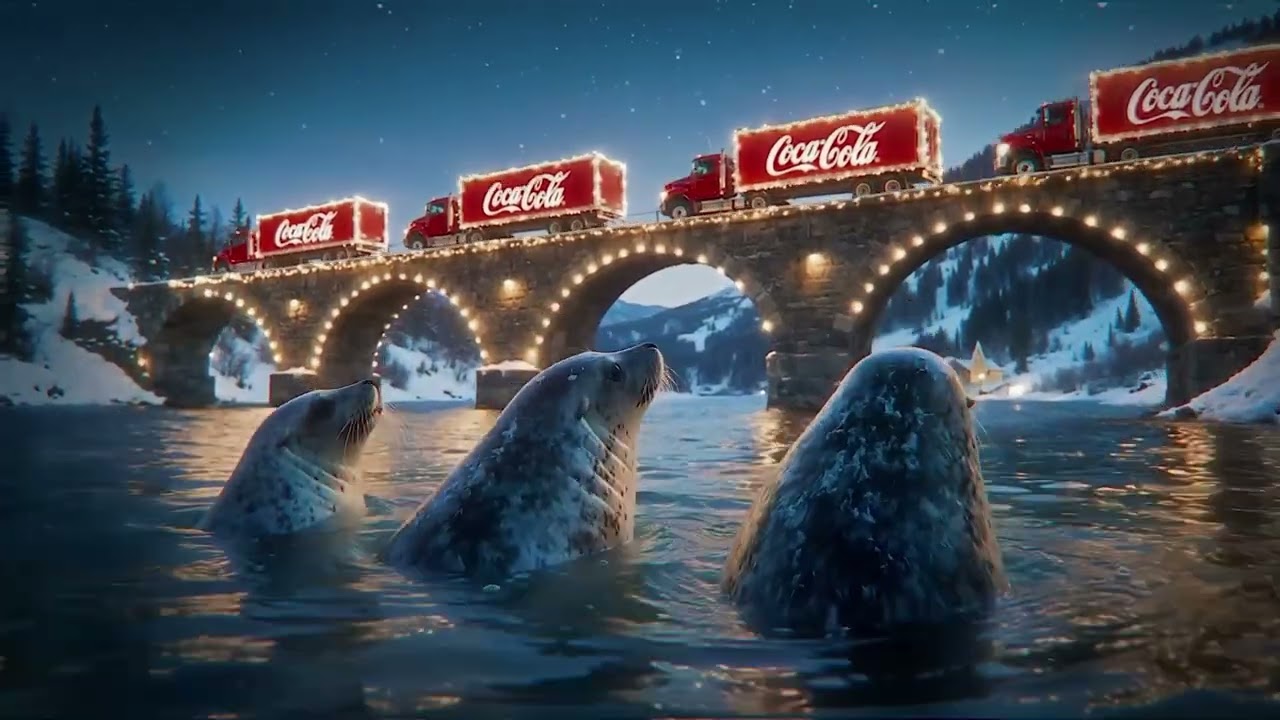
Coca-Cola generated more than 70,000 clips to make its 2025 Christmas advert, and the public liked it less than the one it made the year before. That single fact is the state of AI in advertising in 2026. The tools are faster, cheaper and better than they were. The audience is not more forgiving. It is less.
This piece argues three things. AI improves craft when it is used before the camera, not instead of it. AI destroys trust when it fakes a person, a performance or a product result. And the disclosure rule the industry keeps dodging is simpler than the regulators make it sound.
The ones that got caught
Start with Coca-Cola, because it has now run the same experiment twice. In November 2024 the brand released three fully AI-generated remakes of “Holidays Are Coming”, produced by Secret Level, Silverside AI and Wild Card. Coca-Cola called it the world’s first entirely GenAI-created film on broadcast media. Viewers called it, in NBC News’s round-up, “soulless”. The faces drifted, the trucks changed shape between cuts, and the brand that popularised the modern Santa had outsourced its warmest asset to a diffusion model.
Coca-Cola went again in November 2025 with Silverside and Secret Level, swapping uncanny humans for polar bears, pandas and sloths. Around 100 people worked on it, five of them AI specialists, generating and refining those 70,000 clips in roughly a month instead of a year. Global head of generative AI Pratik Thakar told the press it was “ten times better” than 2024. Chief marketing officer Manolo Arroyo confirmed it was faster and cheaper. Newsweek reported the backlash was louder than the year before, with boycott threats and pledges to switch to Pepsi. One tracker put positive sentiment at 10 per cent after launch, down from 24 before it.
The lesson is not that the animation was bad, although it was inconsistent. It is that Coca-Cola’s Christmas advert exists to say “we spent money on you”. An AI version says the opposite, whatever the render quality.
Toys R Us, McDonald’s and the tone problem
Toys R Us got there first. In June 2024 Toys R Us Studios and Native Foreign, with director Nik Kleverov, released a brand film made with OpenAI’s Sora that showed founder Charles Lazarus as a boy dreaming up Geoffrey the Giraffe. Critics went straight for the artefacts: eyeglasses that changed shape, movement that did not obey physics. The idea was sweet. The execution told everyone the film had been prompted rather than made.
McDonald’s Netherlands made the same mistake with worse timing. “It’s the Most Terrible Time of the Year”, by TBWANeboko with production company The Sweetshop, launched on 6 December 2025 and was made private on 9 December after a wave of complaints, as the BBC reported. It was built heavily with generative AI by The Sweetshop’s ten-person in-house unit over seven weeks. Two human directors originally attached, Mark Potoka and Matt Spicer, resigned after being sidelined. The concept, Christmas as a series of disasters you escape by eating a burger, would have been risky in live action. In AI it read as both cynical and cheap.
Then Gucci. On 25 February 2026 the house posted AI-generated images to trail Demna’s first Milan show, labelled “created with AI”. The BBC recorded the reaction: a luxury brand that sells Italian craftsmanship, using a tool whose only selling point is that it costs less than a photographer. The label was honest. It did not help. Disclosure cannot fix a message that contradicts the brand.
Under Armour and the credits question
The most instructive case is not about output at all. In March 2024 director Wes Walker posted an Under Armour film starring Anthony Joshua and billed it as the first AI-powered sports commercial, made in three weeks from AI video, AI stills, CGI, 35mm and an AI voiceover. Within hours, director Gustav Johansson pointed out that the Joshua footage came from a complete commercial he had directed two years earlier, shot by cinematographer André Chemetoff, with neither credited. TechCrunch tracked the fallout, and Walker eventually had credits added. Marketing-Interactive’s sentiment tracking showed positive mentions falling from 32 per cent to 16.
The Under Armour film was not fake. It was a remix marketed as a revolution. That is the pattern to watch: “AI-powered” is doing a lot of work in a lot of case studies, and the humans whose work sits underneath rarely get a line.
The ones getting it right
The best AI advertising examples share one trait. The AI is the subject or the sketchbook, never the substitute.
Heinz remains the benchmark. In August 2022, Rethink asked DALL-E 2 to draw “ketchup” and found that, whatever the prompt, the model kept drawing Heinz. The A.I. Ketchup campaign turned that into posters, limited-edition bottles and a Clio Gold. Rethink reported more than 850 million earned impressions. The AI made nothing the brand had to defend; it made a point about the brand that only a machine could make.
Nike showed the other legitimate use. For the Travis Scott collaboration in January 2025, director Gibson Hazard’s team generated more than 5,000 Midjourney images in pre-production, then shot and finished the film with conventional VFX. Creative director Jak Bannon described a hybrid workflow, and Creative Bloq contrasted it directly with Coca-Cola’s Christmas mess. Nobody complained, because nobody was asked to admire a render. The AI did the work of a very fast art department, and the audience saw a film.
Then there is the honest low end. Kalshi’s “World Gone Mad” spot for the 2025 NBA Finals was made by PJ Accetturo with Veo 3 for around $2,000. It was chaotic, it looked it, and it never pretended otherwise. A prediction market spending pocket change on a deliberately absurd advert is a coherent message. Coca-Cola doing the same is not.
What the UK rules actually say
The Advertising Standards Authority’s position has been consistent since its first guidance in August 2023: the CAP and BCAP Codes are media-neutral, so if an ad is in scope, the rules apply however it was made. In June 2026 the ASA restated this in four points. AI does not exempt you. Deepfakes of real people that could mislead about endorsement breach the Code. Bias in the model is your liability, not the vendor’s. And automating production or placement does not move responsibility off the advertiser.
On disclosure, CAP’s May 2025 note is blunt. There is no blanket UK requirement to say an ad used AI. Advertisers should ask two questions: would the audience be misled without a label, and does the label clarify or contradict the message? The line worth pinning to the wall is that disclosure alone “is very unlikely to mitigate harm” from a fundamentally misleading ad.
The rulings back that up. On 17 September 2025 the ASA upheld a complaint against Midnite over an AI-generated video of Trent Alexander-Arnold giving a fictional farewell speech, posted to X in May 2025. It carried an “ai-generated parody” caption and a safer gambling line. Neither mattered. The ASA found it was an ad, that Alexander-Arnold has strong appeal to under-18s, and that it breached gambling rules 16.1, 16.3 and 16.3.12. In March 2026 the regulator upheld complaints against Saeta Tech’s PixVideo, an AI video tool advertised with a demo that digitally stripped a woman’s clothing, and against WiggyDog, an AI robot puppy whose Meta ads showed capabilities the advertiser could not evidence. Earlier rulings against Polyverse, Cosmos and Stripe & Stare cover offensive AI imagery, gender stereotypes and automated placement.
The volume is changing too. The ASA’s Active Ad Monitoring System processed around 28 million ads a year from 2024 and is expected to review 40 million in 2026. AI-generated ads are now being caught by AI-driven regulation before a single complaint arrives.
Ofcom, the Online Safety Act and Europe
Ofcom does not regulate advertising content, but it regulates the platforms that carry it. The Online Safety Act 2023 brings the sharing of certain deepfakes within scope, and Ofcom can fine services up to 10 per cent of qualifying worldwide revenue for failing their duties. Its Deepfake Defences research, first published in July 2024 and followed by an attribution toolkit in 2025, sets out the measures it expects platforms to weigh: watermarks, provenance metadata and visible labels. For advertisers the practical effect is that a synthetic film of a real person can now trip a platform’s duties as well as the CAP Code. Across the Channel, the EU AI Act’s transparency obligations took effect on 2 August 2026, requiring deepfakes to be disclosed as artificially generated. Any UK brand running work in Europe is already living under a labelling rule.
What the holding companies are betting
The money says the industry has decided. WPP raised its annual spend on WPP Open, its AI operating system, from £250 million in 2024 to £300 million in 2025 and has kept it there. Publicis committed €300 million over three years to CoreAI from January 2024. Omnicom has built its pitch around Omni, its AI-enabled platform, while chief executive John Wren keeps insisting the differentiator is elsewhere: “If everybody had the same generative AI tools, what would make a difference? A brilliant creative idea.” That is the correct position. It is also a convenient one for companies spending nine figures on the tools.
Ad Ranking’s view is that the holding companies are right about the plumbing and wrong to be quiet about the output. Not one of them has published a client-facing rule on when AI-generated humans, voices and product demonstrations must be labelled. Until they do, every case above is a preview.
The disclosure rule Ad Ranking would apply
The regulators are asking whether a label helps. We think the question is what the label is for. Nobody needs to know a storyboard was made in Midjourney, any more than they needed to know it was made in Photoshop. People do need to know when the thing they are being asked to believe is not real. So the rule is this: disclose synthetic evidence, not synthetic tools.
That means three things must always be labelled, in the frame and not the caption. A synthetic human presented as a person, whether a deepfake of a celebrity or an invented presenter. A synthetic performance, meaning a voice, an endorsement or a testimonial that no one gave. And a synthetic product result, which is any before-and-after, demonstration or capability the product cannot be shown doing for real. Everything else is production, and production has never needed a credit on screen.
Under that rule, Heinz and Nike need no label. Gucci’s label was correct and irrelevant. Midnite’s label was present and insufficient, exactly as the ASA found. And Coca-Cola’s problem was never disclosure. Everyone knew. That was the problem.
What to steal
- Use AI before the camera, not instead of it. Nike’s 5,000 Midjourney frames became a shot list, not a film.
- Make the machine the subject when the brand can win that argument. Heinz proved its distinctiveness by asking a model to draw ketchup.
- Never let AI carry the emotional asset. If the advert’s job is to say “we care”, a render says the opposite.
- Label synthetic evidence, in the frame: synthetic people, synthetic performances, synthetic product results. Tools do not need a label.
- Remember a label is not a defence. The ASA’s Midnite ruling stands regardless of the “parody” caption, and CAP says disclosure alone rarely mitigates harm.
- Credit every human whose work the model was fed or cut around. Under Armour’s film became a scandal over a missing name, not a missing pixel.
- Match the budget signal to the brand. A $2,000 Veo spot suits a prediction market. It does not suit the company that owns Christmas.
- Assume the regulator sees it first. The ASA expects to scan 40 million ads in 2026, so the “nobody complained” defence has expired.