 63/100
Bisto ‘Aah Nights’: how a 1919 catchphrase became a night of the week
McCann Erickson took the Bisto Kids' hundred-year-old 'Aah' and turned it into a booked appointment. A review of the Bisto advert that sold an occasion, not gravy.

One of advertising's most repeatable ideas, executed with the discipline to leave it alone, but marked down because Anheuser-Busch never published the effectiveness evidence.
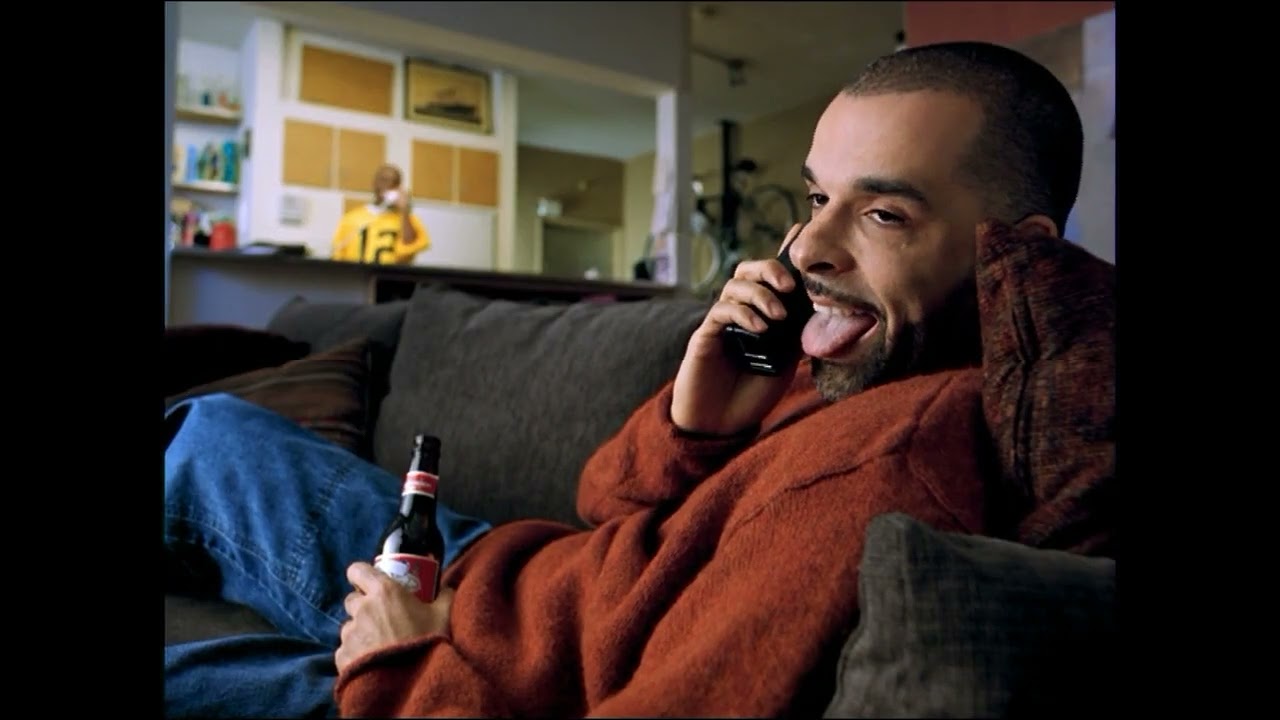
Four men on four phones, a football game on in the background, and a script that consists almost entirely of one word said badly. Budweiser’s “Whassup” is the least written famous advert ever made, and that is the whole point of it. It was lifted almost wholesale from a short film a director had cut to prove he could get a job. The take: an advert that won by taking something real and having the sense not to improve it.
Budweiser at the end of the 1990s did not have an awareness problem. It had the opposite one: a brand so ubiquitous in American sport that no message could get through the wallpaper. Anheuser-Busch had already worked the talking-animal seam hard with the Frogs and the lizards. The job for DDB Chicago was to find a way back to actual drinkers without another gimmick, and to do it in the media environment Budweiser owned, which was live sport.
The specific difficulty is that beer advertising in that market is a genre with rules, and the rules are exhausting. There is the lifestyle version, in which attractive strangers enjoy a bar. There is the humour version, in which an animal or an idiot does something. Both require the viewer to accept a premise before the brand arrives, and by 1999 American drinkers had been asked to accept a very large number of premises.
Charles Stone III made True in 1998 as a calling card, a short designed to prove he could direct performance rather than pop promos. He cast himself and his friends, among them Fred Thomas, Paul Williams, Terry Williams and Jimmy “Puerto Rock” Perez, and shot them greeting each other on the phone in a New York flat. It went round the short film festivals and then round the industry on VHS. Vinny Warren, a creative director at DDB Chicago, got hold of what MEL Magazine’s oral history describes as a badly degraded dub of it from a producer friend.
Warren noticed that everyone he showed the tape to would shout the greeting at him the next time they met. That is the only research finding the idea ever needed. His contribution as a writer was a single added line, “Watching the game, havin’ a Bud”, which is all the product the spot contains. Anheuser-Busch bought it, and Stone was hired to direct his own short again with the same cast, minus one, on a beer budget.
The direction is a series of static, locked-off shots of men holding telephones. There is no camera move, no score, no lighting that draws attention to itself, and the rooms look like rooms. Every technical decision is a decision not to do something, which in a Super Bowl year is a genuinely difficult call to hold. The comedy is carried entirely by escalation and by the fact that the cast are actually friends, so the timing has a shape no casting session produces.
The word is the craft. It is not a slogan, it is a sound, and its length and stupidity are what make it repeatable across a room, a bar or a school corridor. Compare it with the beer advertising of the same era, which was almost all built on a premise a viewer has to explain. This one is a noise you can simply make.
Watch what the edit does not do. Nobody reacts to camera, nobody delivers a line to the audience, and there is no cutaway to the product beyond the bottle already in shot. The spot behaves as though it has been left running rather than constructed, which is a much harder effect to achieve than it looks and almost impossible to defend in a client meeting.
It also matters that the spot has no joke ending. It just stops, on a group of men who have said nothing and enjoyed it enormously. That refusal to resolve is what lets the audience finish it themselves, over and over, for the next two years.
The first airing was on Monday Night Football on 20 December 1999. It then ran in Super Bowl XXXIV in January 2000, in the slot after the half-time show, and the catchphrase was in general circulation within days. On business evidence, published detail is thinner than the fame suggests: The Drum, citing New York Times reporting, credits the campaign with helping Anheuser-Busch lift sales by roughly 2.4 million barrels. Anheuser-Busch never published a case paper with the granularity that, say, Old Spice later did.
The awards were less ambiguous. It took the Film Grand Prix at Cannes Lions in 2000, won a Grand Clio, and was inducted into the Clio Hall of Fame in 2006. It also picked up Emmy nominations, which for a commercial in that period was rare.
The clearest measure of reach is not an advertising metric at all. A novelty record built on the line, “Wassuup” by Da Muttz, entered the UK singles chart on 9 December 2000, peaked at number 11 and spent eleven weeks on the chart, according to the Official Charts Company. An American beer commercial had produced a British top twenty hit within a year, in a market where Budweiser was a minor brand.
It was parodied in Scary Movie in 2000, adopted as an entrance ritual by WWE’s Dudley Boyz, and turned into a Cartoon Network superhero skit. Budweiser itself ran variants for two more years, including “Whassup Girlfriend”, a wasabi version and an alien version, plus a Super Bowl XXXV spot that parodied its own audience with a set of well-spoken men asking “what are you doing?” instead. The original cast reunited in 2008 for a politically themed short backing Barack Obama, and again in 2020 for a lockdown reunion, as the campaign’s record sets out. Very few adverts get a second life; this one has had three.
“Whassup” is the moment mainstream American beer advertising stopped writing at people and started listening to them. It also, uncomfortably for the industry, demonstrated that the best available idea was already made, by someone outside the agency, on no money. The modern practice of hiring the director because of a spec film, or building a campaign on a piece of found culture, runs straight through here.
There is a harder lesson underneath the charm. The campaign put a group of Black friends on the biggest advertising stage in America being ordinary, funny and entirely unexplained, at a point when mainstream beer advertising did no such thing. Nothing in the film comments on that, which is precisely why it worked.
The comparison worth drawing is with the long-running drinks work that wins on craft rather than catchphrase, which we cover in our review of the Guinness adverts. Guinness builds cathedrals. Budweiser recorded four blokes on the phone and got the same number of years out of it.
One of the two or three most repeatable ideas advertising has ever produced, executed with the discipline to leave it alone, and still travelling more than a quarter of a century later. It is marked down on effectiveness only because Anheuser-Busch never published the evidence, so the strongest available number is a single barrel figure reported second hand rather than an audited case. Bravery sits mid-table too: this was a beer brand buying a proven crowd-pleaser, not risking anything it could not afford to lose. Our full rubric is set out in how we score, and the campaign’s place in the canon is argued in our best advertising campaigns ranking.

He plans, buys and reviews advertising for a living, and helps score campaigns on the site against the same five Crown Score criteria alongside other authors and contributors.
63/100McCann Erickson took the Bisto Kids' hundred-year-old 'Aah' and turned it into a booked appointment. A review of the Bisto advert that sold an occasion, not gravy.
 73/100
One photograph of Heinz Beanz on two biscuits, no paid media, a day of brand replies and a debate in the House of Commons. Frank PR's Beanz on Bix, reviewed.
 79/100
BMP DDB gave the jokes to Rowan Atkinson and the product line to his assistant. Seventeen films, nine British Arrows, an IPA Gold and a cinema franchise later, a full review.