 63/100
Bisto ‘Aah Nights’: how a 1919 catchphrase became a night of the week
McCann Erickson took the Bisto Kids' hundred-year-old 'Aah' and turned it into a booked appointment. A review of the Bisto advert that sold an occasion, not gravy.

The difficulty is the message, and a film with fourteen words of copy moved Honda's UK sales 28 per cent and close to £400 million of revenue.
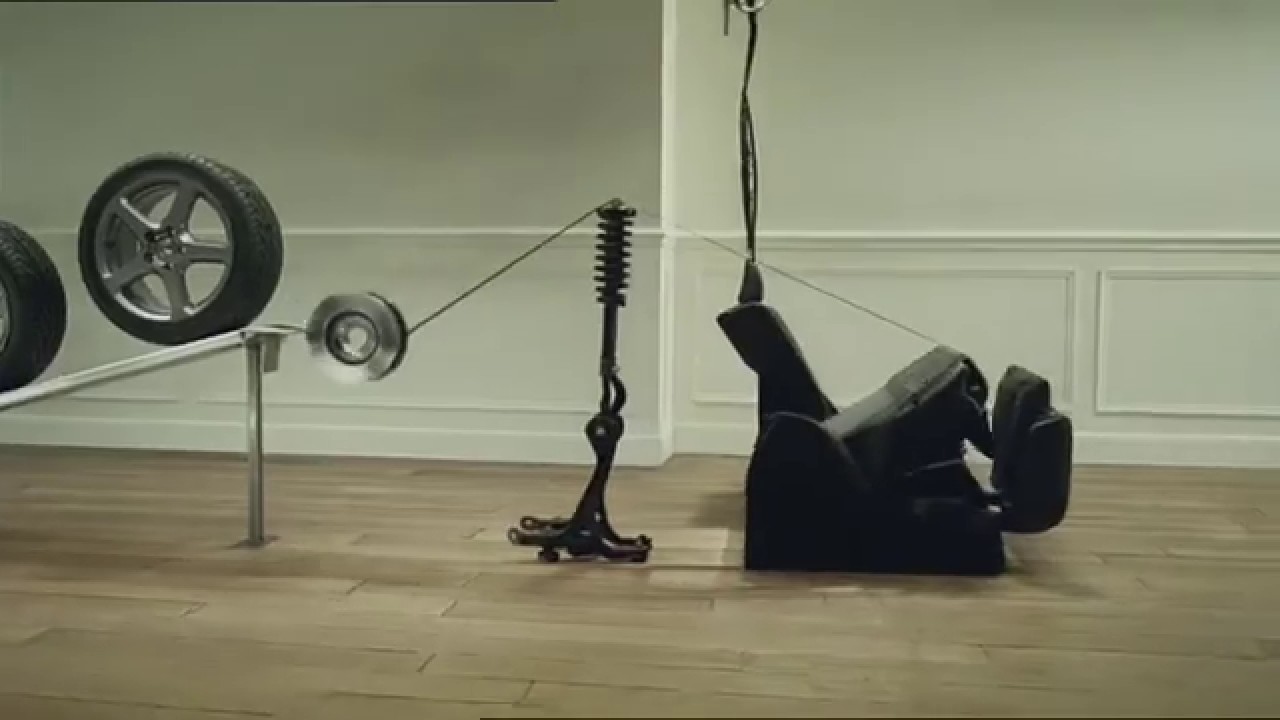
A transmission bearing rolls down a wooden board and taps a synchro hub. One hundred and twenty seconds later a Honda Accord rolls off a trailer under its own weight and a voice asks whether it is not nice when things just work. In between, a car’s worth of components takes itself apart and puts itself back together, and none of it is computer generated. Twenty three years on, that is still the most remarkable sentence anyone can write about a car advert.
Our take: “Cog” argues for Honda’s engineering by performing engineering, which is why it needs only fourteen words of copy. It is also the rare piece of showing off that a finance director would sign off twice.
Honda’s share of the European car market had been falling since 1998, and Nissan had taken its place as the second Japanese manufacturer in Europe. Buyers accepted that the cars worked and decided the brand was dull. In one survey, a quarter of respondents said they would not dream of buying a Honda as their next car. Wieden+Kennedy London arrived in 2001 with a strategy built on Honda’s Japanese motto, Yume No Chikara, the power of dreams.
The stated goal was five per cent of the UK market inside three years and a shift in image from dull but functional to warm and human, on a smaller budget than the previous agency had demanded. Planner Russell Davies turned that into a “Book of Dreams” that creatives worked from instead of a conventional brief, a piece of thinking that won Gold at the APG Awards. “Cog” was commissioned in 2002 to launch the seventh-generation Accord, with Tony Davidson and Kim Papworth putting Matt Gooden and Ben Walker on it. The campaign around it, including the later films “Sense” and “Everyday”, ran to £6 million.
The thought is one sentence long, which is exactly why it travelled. Take an Accord apart, lay the parts out so each one knocks over the next, and let the chain reaction stand as the proof that the parts are properly made. Honda’s executives were intrigued and unconvinced in equal measure, and demanded a rough cut using real components before releasing the £1 million production budget. The reference points were a children’s board game, Caractacus Potts’s breakfast machine in Chitty Chitty Bang Bang, and a Swiss art film we will come back to.
Honda also wrote features into the script. The client insisted that a door with a wing-mirror indicator and the rain-sensitive windscreen appear in the final cut, because both were being pushed in the sales brochures. That is worth sitting with: the most admired commercial of the decade contains client-mandated product features. The craft is that you cannot feel them.
Antoine Bardou-Jacquet came from music videos, including Air’s “How Does It Make You Feel” and Alex Gopher’s “The Child”, and he wanted as little computer-generated imagery as the job would allow. He spent two months on conceptual drawings and four more on physical testing, breaking the script into segments of one or two interactions and discarding anything that would not repeat. Airbag explosions and collisions between the front and rear sections of the car were abandoned on those grounds. Before the set was even designed, a team of engineers, effects technicians, car designers and a sculptor spent a month working with a stripped Accord.
The finished film is not a single take, and the crew never claimed it was. It is two continuous sixty-second dolly shots from a technocrane, joined in post production at the moment the exhaust silencer rolls across the floor. Four days of filming produced them, two days for each minute, in seven-hour sessions. Some parts had to be positioned to within a sixteenth of an inch, and small shifts in temperature, humidity and settling dust ended runs again and again.
The figure everyone repeats is 606. It is wrong. Campaign’s making-of feature puts the real number at roughly 100 takes across testing and filming combined, and the 606 story has been debunked. What is true is that on the first day it took ninety minutes to get the opening bearing to roll correctly into the second one.
For most of its length “Cog” carries no music at all, only the sound of parts hitting parts, which is what makes it read as evidence rather than as styling. Johnnie Burn handled the sound design. The silence breaks when the Accord’s CD player fires up and plays The Sugarhill Gang’s “Rapper’s Delight”, a joke about the car’s own electronics that also releases two minutes of held breath. Garrison Keillor then delivers the only line of copy, unhurried and slightly amused.
Isn’t it nice when things just work?
Garrison Keillor, closing line of “Cog”
The full 120-second cut aired about ten times in total, all within ten days of launch, and only in the United Kingdom, Sweden and Australia. Its debut filled an entire ITV commercial break during the Brazilian Grand Prix on 6 April 2003, and the remaining slots were bought for impact, including the Champions League tie between Manchester United and Real Madrid. Honda then moved to a sixty-second cut and five thirty-second versions carrying interactive options on Sky Digital. The day after the debut, Honda’s website took more hits than at any point in its history.
The interactive layer is the underrated half of the campaign. More than 250,000 people opened the red-button menu and spent an average of two and a half minutes inside it, 10,000 requested a brochure or the making-of DVD, and Honda used the data to book test drives. The £32,000 spent on BSkyB placements produced a bigger response than a previous £1 million direct mail campaign. The DVD also went out as an insert in 1.2 million newspapers in the first week.
The business numbers hold up under inspection. Honda’s UK vehicle sales rose 28 per cent despite lower marketing and PR spend and prices rising relative to rivals, and monthly dealership visits went from around 3,500 to 3,700 with conversion up from 19 to 22 per cent. “Cog” has been credited with adding close to £400 million to Honda’s revenue. The work also took Gold at the APG Awards for the most effective commercial for an established brand, which is the kind of prize that matters more than the shiny ones.
Shortly after transmission, Wieden+Kennedy received a letter from Peter Fischli and David Weiss, the Swiss artists behind the 1987 film Der Lauf der Dinge, known in English as The Way Things Go. Their film is a thirty-minute chain reaction of tyres, ladders, fire and foam, and it was well known inside the advertising industry, which had approached them for rights before and been refused. The letter listed the similarities and warned that they were considering legal action over the commercialisation and simplification of the film’s content. They told Creative Review they would not have given permission had anyone asked.
The agency’s position was awkward precisely because it had never hidden the influence: W+K acknowledged the film as an inspiration and had circulated copies to its writers. No lawsuit was ever filed. The bill was paid at Cannes instead, where “Cog” went in as the overwhelming favourite for the Film Grand Prix and finished third behind Spike Jonze’s “Lamp” for IKEA. Ben Walker later told Adweek that jurors had told him they did not want to be seen awarding something people in some corners had called a copy.
“Cog” became the most awarded commercial in history, a record it held until Guinness’s “Tipping Point” took it in 2007. It won Gold at Cannes, the Grand Clio, a Platinum Honour at the Creative Circle Awards and Commercial of the Year at the British Television Advertising Awards. It was also the most copied: a 118 118 parody, sixty-five BBC local radio versions made with the agency’s blessing, and a run of chain-reaction spots including Guinness’s own attempt at the form. The United States Coast Guard asked to use it in training as a lesson in attention to detail.
Note what it could not do. It could not run for years, it could not travel across formats, and the cost of 120-second slots kept it out of almost every market including the United States, where most people saw it online. The thing with legs was the platform underneath it, “The Power of Dreams”, which W+K carried through “Sense”, “Grrr” and “Choir”. “Cog” sits near the top of our ranking of the best advertising campaigns for what it proved, not for how long it ran.
“Cog” is canonical for the right reason: the difficulty is not the point, the difficulty is the message, and Honda got a 28 per cent sales rise and close to £400 million of revenue out of a film with fourteen words in it. It loses marks on legs, because a two-minute in-camera epic can headline a campaign but cannot be one, and on the originality of the founding thought, which the agency itself admitted it borrowed. Everything else, from the two-shot discipline to the withheld music to Keillor’s unimpressed delivery, is as close to faultless as television advertising gets. Our scoring method is explained in how we score.

He plans, buys and reviews advertising for a living, and helps score campaigns on the site against the same five Crown Score criteria alongside other authors and contributors.
63/100McCann Erickson took the Bisto Kids' hundred-year-old 'Aah' and turned it into a booked appointment. A review of the Bisto advert that sold an occasion, not gravy.
 73/100
One photograph of Heinz Beanz on two biscuits, no paid media, a day of brand replies and a debate in the House of Commons. Frank PR's Beanz on Bix, reviewed.
 79/100
BMP DDB gave the jokes to Rowan Atkinson and the product line to his assistant. Seventeen films, nine British Arrows, an IPA Gold and a cinema franchise later, a full review.