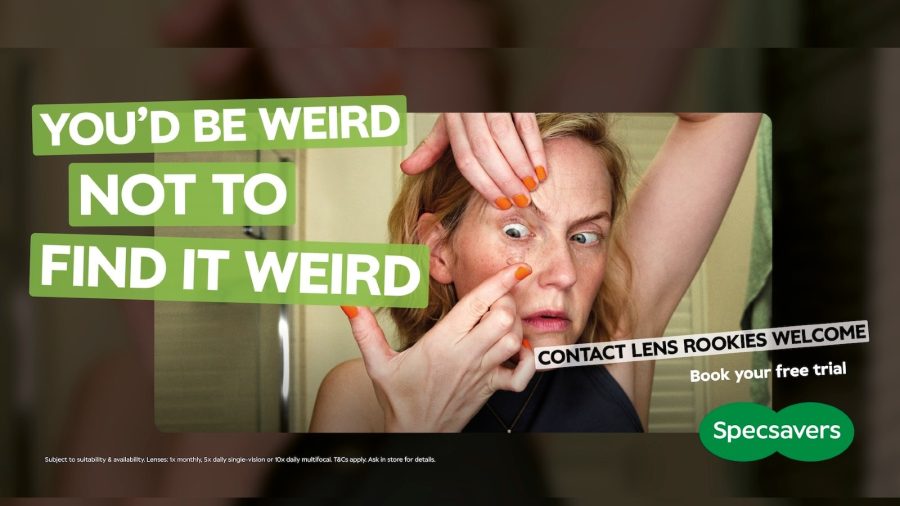
Specsavers advert: Contact Lens Rookies Welcome shows the awkward first try
Specsavers' first fully integrated influencer campaign targets 45 to 59 year old glasses wearers who have never tried lenses, by showing the fumble rather than the finish.

The most durable endline in British advertising, marked down on bravery for repeating a safe joke and on effectiveness for a respectable rather than spectacular thirty-year return, but close to unbeatable on legs.
Very few advertising lines become sentences that people say to each other. “Should’ve gone to Specsavers” is one of them, and it has been doing it since 2003. The line was written in 2002 by Graham Daldry, an in-house creative director with a PhD in English literature, and it has outlasted almost every agency campaign launched alongside it.
Our take: the most efficient endline in British advertising, because it is not a claim about the product, it is a machine for generating scripts.
Daldry joined Specsavers in 1999 as its in-house creative director, arriving after a campaign in which Stephen Hawking described the solar system as seen through Specsavers glasses. Striking, but not the tone of a chain built on being approachable. He spent a couple of years hunting for a new line, and told Little Black Book, in an interview quoted at length by the etymology site Word Histories, exactly what he was looking for.
I came up with the line in 2002. We had been looking for a new line for a couple of years and I was on the look out for something with an angle that would drive great creative ideas. We had used “Need glasses?” which produced good scripts in a very similar way, but could have belonged to any brand.
Graham Daldry, interviewed by Laura Swinton for Little Black Book
That is the whole brief in one paragraph. He was not looking for a positioning statement or a promise, he was looking for a device that would keep producing work, and one that no rival could borrow. “Should’ve gone to Specsavers” cannot be said about Boots or Vision Express, because the brand name is load bearing inside the joke.
The structure of every execution is identical. Somebody misreads the world because of their eyesight, the mistake plays out to its most humiliating conclusion, and the line arrives as a verdict rather than a sell. There is no product demonstration, no price, no range, and no eyewear on screen for most of the running time.
It is a format rather than a campaign, which is why it has absorbed Thunderbirds, Postman Pat, the Mr Men, John Cleese reprising Basil Fawlty and Gordon Ramsay without ever needing to be reinvented. Compare it with Volkswagen’s Think Small, another idea that survived decades because it described a way of behaving rather than a benefit. Both give a brand somewhere to stand instead of something to say.
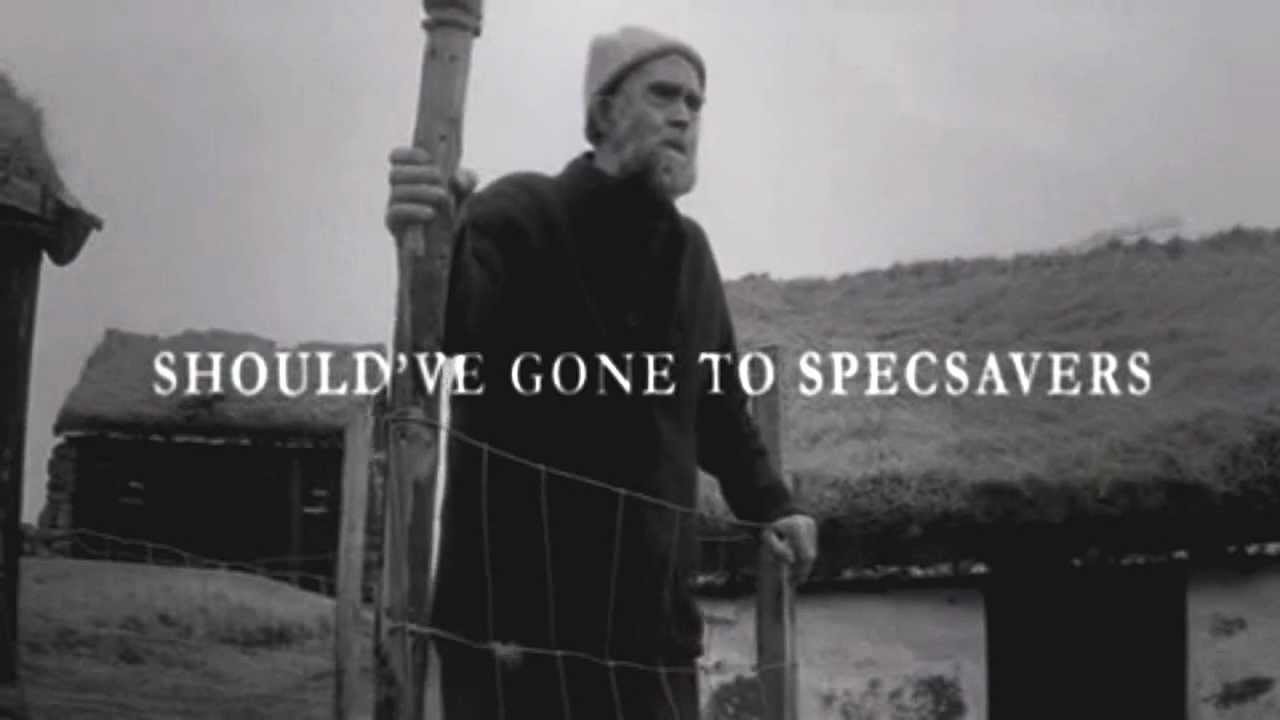
The best execution is Collywobble, in which a shepherd brings his flock down for shearing and mistakenly shears his sheepdog. It is shot in black and white and set to Mo Ghile Mear, a seventeenth century Irish lament sung by Una Palliser, which is an absurdly serious piece of music to hang a sight gag on. That mismatch is the joke. The Drum’s readers voted it into the hundred best ads of all time.
The production is worth noting because it undercuts the usual snobbery about in-house work. Specsavers’ own crew, led by director Chris Palmer, shot it in the Faroe Islands in February with roughly three hours of daylight a day, in weather cold enough that a nearby waterfall froze solid. The result looks like a short film that happens to end on a joke, and it holds the frame long enough for the punchline to land on the shepherd’s face rather than on a logo.
The format also travels off television faster than most. When the wrong film was announced as Best Picture at the 2017 Academy Awards, Specsavers was live on JCDecaux digital screens by four o’clock the next afternoon with a shot of the red envelope and the headline “Not getting the Best Picture?”. In 2022, relaunching the line after a two year pandemic pause, Talon and Specsavers ran posters that appeared to have been installed by someone with bad eyesight, including one pasted at ninety degrees up a wall and one apparently stuck over the installer’s own ladder. Very few endlines can be performed by the medium itself.
Specsavers took an IPA Effectiveness gold in 2014 for a paper covering thirty years of advertising, written with Manning Gottlieb OMD. It attributes £1.1bn of incremental profit to advertising investment of nearly £500m across that period, and credits a strategy of continuous presence at relatively high spend, broad appeal, a commitment to humour and distinctive brand assets that build memory structure.
The second piece of evidence is more interesting, because it comes from subverting the line rather than repeating it. The “I don’t go to Specsavers” campaign, aimed at people who had ruled the brand out, won another IPA gold in 2024. The paper reports £19.8m of incremental profit, a 32 per cent increase in home visit volumes and around 582,000 previous rejecters booking an eye test.
Two IPA golds ten years apart, both hanging off the same five words, is a rare thing. The honest caveat is that thirty years of £500m spend producing £1.1bn of profit is a solid return rather than a spectacular one, and the 2014 paper’s strength lies in consistency rather than in a single sharp effect. This is advertising that compounds.
The clearest measure of the campaign is not a chart, it is usage. Word Histories tracks “go to Specsavers” as an ordinary British and Irish idiom, appearing in Irish newspaper letters pages and match reports within a couple of years of the ads starting. When Dominic Cummings claimed in May 2020 that he had driven to Barnard Castle to test his eyesight, the country reached for “should have gone to Barnard Castle” without anyone needing to explain the reference.
Daldry left in May 2020 after two decades, having grown a team of six art workers into an in-house agency of more than eighty people responsible for all of Specsavers’ UK consumer advertising, as Campaign reported at the time. The line survived his departure, which is the test any platform eventually faces.
In May 2026 Specsavers changed it for the first time. A new global platform stretches the construction into “Should’ve gone to [problem] Savers”, with the first UK film, Home Visits from Mrs Wren’s Journey Savers, narrated by Rob Brydon and running across TV, cinema, radio, out of home, print and digital. Global creative director Richard James framed it as building on the heritage rather than replacing it. Stretching a phrase the public already owns is the single riskiest thing this brand can do, and it is worth watching closely.
Nothing in British advertising has run this long, this consistently, for this little strategic drift, and the phrase now belongs to the public rather than to the brand. It is marked down on bravery, because the format is deliberately safe and repeats a proven joke, and on effectiveness the return is respectable rather than exceptional for the spend involved. On legs it is close to unbeatable, which is exactly the quality most marketers claim to want and almost none have the patience to build. Our scoring method is set out in how we score.

He plans, buys and reviews advertising for a living, and helps score campaigns on the site against the same five Crown Score criteria alongside other authors and contributors.
Specsavers' first fully integrated influencer campaign targets 45 to 59 year old glasses wearers who have never tried lenses, by showing the fumble rather than the finish.
 63/100
McCann Erickson took the Bisto Kids' hundred-year-old 'Aah' and turned it into a booked appointment. A review of the Bisto advert that sold an occasion, not gravy.
 73/100
One photograph of Heinz Beanz on two biscuits, no paid media, a day of brand replies and a debate in the House of Commons. Frank PR's Beanz on Bix, reviewed.