 63/100
Bisto ‘Aah Nights’: how a 1919 catchphrase became a night of the week
McCann Erickson took the Bisto Kids' hundred-year-old 'Aah' and turned it into a booked appointment. A review of the Bisto advert that sold an occasion, not gravy.
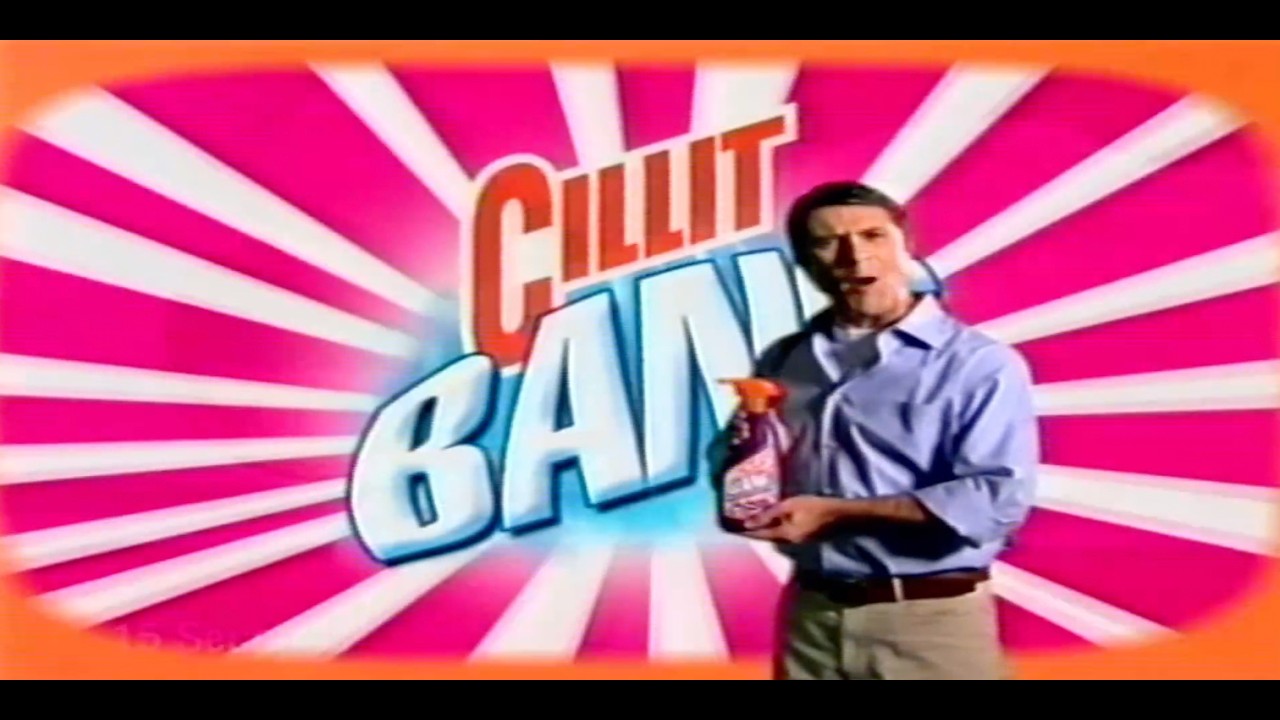

A brutally clear demonstration film that built a four per cent share from a standing start and forced Procter & Gamble to answer it, held back by thin published effectiveness evidence beyond the first year, a 2013 ASA ruling the brand walked into by overclaiming in its own voiceover, and the 2005 blog episode that remains British advertising's most instructive own goal.
A man in a blue shirt shouts his own name at you, drops a filthy penny into a beaker and pulls it out shining. “Bang, and the dirt is gone.” Cillit Bang launched in Britain in November 2004 with no heritage, an awkward name and a £5m television budget, and inside a year it had a cult figure and four per cent of the household cleaning market. Our take: the least fashionable advertising of its decade and among the most commercially literate, undone twice by the brand’s own attempts to be clever.
Reckitt Benckiser owned Harpic, Dettol and Mr Sheen but had no direct answer to SC Johnson’s Mr Muscle. Cillit Bang was already established in Europe, and in August 2004 Marketing Week reported the plan to bring it to Britain with a £5m television campaign breaking at the start of November, J Walter Thompson and Euro RSCG on the agency roster and OMD UK on media.
The brand’s difficulty was stated in that same piece by an industry insider: the name is quite strange at first, and lacks the obvious ring of Mr Muscle. Reckitt’s answer was that advertising would establish the brand in the minds of consumers, which is a bold thing to say out loud about a product nobody had asked for.
The category context matters. Household cleaning was growing, and the growth was coming from products that claimed raw power rather than emotional warmth. Flash held 33 per cent of the market and Cif 21 per cent, so a challenger had to be believed rather than liked.
J Walter Thompson’s answer was to shoot the launch film in the style of a home shopping channel infomercial and hand it to a man who never stops shouting. Barry Scott, played by the actor Neil Burgess, is not a character in any dramatic sense. He is a delivery mechanism for a demonstration.
The choice is smarter than it looks. The infomercial is the only television format whose entire grammar is proof, and a new brand with no reputation needs proof more than it needs charm. Borrowing a discredited form also solves the awareness problem, because an ad that looks like a mistake gets talked about.
The strategic thinking was explicit. “It was critical we had a campaign with cut-through,” the Cillit Bang brand manager Duncan Ramsay told Marketing Week in November 2005. “Barry Scott has been a key part of that.”
The penny is the whole campaign. A discoloured coin goes into the liquid, comes out clean, and the viewer has been given a controlled experiment that takes four seconds and requires no belief in the brand at all. Industry observers quoted by Marketing Week in 2005 called it a classic rescue campaign built on the drama triangle: a problem, and a second party who arrives and solves it for you.
The performance is calibrated to be slightly wrong. Burgess plays every line at the same volume, which flattens the emotional range to zero and makes the product claim the only variable in the film. That is why the work parodies so easily and why the parodies still carry the proposition.
Adrian Goldthorpe, then at Futurebrand, put the strategic logic to Marketing Week in a line worth keeping. People just want to get grime off the bath, they do not want to feel sexy or emotional while they are doing it. The craft achievement is having the nerve to build a campaign on that and nothing else.
On 30 September 2005 the writer Tom Coates published a post on his blog about his father, whom he had not seen for almost thirty years. Among the replies was a comment signed Barry Scott, offering warm advice about reconciliation and linking to cillitbang.com.
Coates did what nobody had planned for. He looked up the commenter’s IP address, traced it to servers belonging to the advertising group Young & Rubicam and published the trail. His verdict on marketing a cleaning product inside a post about family estrangement ran through revolting, cynical and dishonourable, and the post travelled.
On 4 October 2005 Coates published the response he received from an address at Cohn & Wolfe, signed “The Cillit Bang team”. It conceded that Barry Scott is a marketing creation whose awareness the senders had been responsible for raising, called the posting unplanned and an error of judgement, and apologised unequivocally.
“The posting on 30th September was unplanned and an error of judgement and we unequivocally apologise for this. We recognise that it was inappropriate in context.”
Email from the Cillit Bang team, published on plasticbag.org, 4 October 2005
Coates accepted the apology and closed the matter. The episode is now a fixed reference point in the argument about brands appearing in spaces that do not belong to them, and it happened a year before Twitter and three before brand social teams existed as a job title.
Barry Scott returned in November 2012 after a six-year absence. The Drum reported a £5m “Turbo Charged” push, first airing on ITV at 19:45 on 19 November 2012 in a Coronation Street break, with Reckitt Benckiser’s UK marketing director Jérôme Lemaire arguing that Barry’s directness reflected the Turbo Power message of removing stains in seconds.
Removing stains in seconds was the problem. Five viewers complained that the Havas Worldwide London film exaggerated what the product could do, citing a tank in which a lump of limescale dissolves under on-screen text reading “seven minutes”, and a sequence showing taps and kitchen surfaces cleaned while the voiceover claims limescale is gone in seconds.
The ASA did not uphold the complaint about the tank, accepting Reckitt Benckiser’s argument that the on-screen seven-minute message clarified the demonstration. It did rule against the second sequence. Reckitt Benckiser had substantiated the “gone in seconds” claim with video evidence supplied to Clearcast while acknowledging that the level of limescale shown would probably need around 20 seconds to dissolve, and on 10 April 2013 the ad was barred from being broadcast again in that form.
The launch year evidence is strong for a standing start. Mintel expected Cillit Bang sales to reach £6m in 2005, giving the brand an immediate four per cent share of a UK household cleaning market it valued at £159m by the end of that year, in a category that had grown 12 per cent since 2003.
The competitive response is the better indicator. Procter & Gamble launched Flash Ultimate for January 2006, positioned head to head against the Cillit Bang range, and both Flash and Cif lost share as Reckitt’s position strengthened. Market leaders do not build products to answer advertising that is not working.
What is missing is any published long-run effectiveness case. There is no IPA paper, no Effie and no Cannes Creative Effectiveness entry in the public record, so the evidence stops at a strong first year and a rival’s counter-launch. That is the reason for the effectiveness score, and the reasoning is set out in how we score.
Barry retreated from screens after 2018 and the internet filled the gap with rumours, including a persistent suggestion that he had died. In March 2026 the brand turned that into the campaign. Creative Review reported a social comeback from the PR and social agency One Green Bean, built as a tell-all faux documentary in which Barry accounts for his wilderness years, human scarecrow and race starter among them.
One Green Bean’s managing director Rich Tompkins framed the strategy as harnessing an existing cultural interest rather than manufacturing one, and would not confirm whether Barry is back permanently. The instinct is right. Reviving a mascot works when the audience has already been keeping him alive without you.
The commercial backdrop has changed underneath all this. In July 2025 Reckitt agreed to divest its Essential Home business, Cillit Bang included, to Advent International at an enterprise value of up to $4.8bn while retaining a 30 per cent stake. Barry’s second act belongs to different owners.
A brutally clear demonstration film that built a four per cent share from nothing in a year and forced Procter & Gamble to answer it, held back by thin published effectiveness evidence beyond that first year, by a 2013 ruling the brand walked into by overclaiming in its own voiceover, and by the 2005 blog episode that remains British advertising’s most instructive own goal. Where it sits against the rest of the canon is argued in our best advertising campaigns ranking.

He plans, buys and reviews advertising for a living, and helps score campaigns on the site against the same five Crown Score criteria alongside other authors and contributors.
63/100McCann Erickson took the Bisto Kids' hundred-year-old 'Aah' and turned it into a booked appointment. A review of the Bisto advert that sold an occasion, not gravy.
 73/100
One photograph of Heinz Beanz on two biscuits, no paid media, a day of brand replies and a debate in the House of Commons. Frank PR's Beanz on Bix, reviewed.
 79/100
BMP DDB gave the jokes to Rowan Atkinson and the product line to his assistant. Seventeen films, nine British Arrows, an IPA Gold and a cinema franchise later, a full review.