 63/100
Bisto ‘Aah Nights’: how a 1919 catchphrase became a night of the week
McCann Erickson took the Bisto Kids' hundred-year-old 'Aah' and turned it into a booked appointment. A review of the Bisto advert that sold an occasion, not gravy.
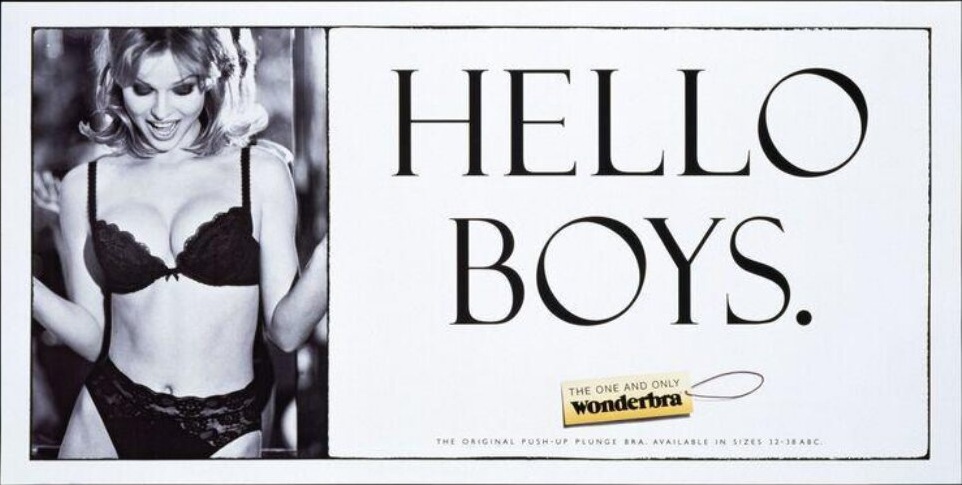

The cleanest proof in British advertising that one photograph and two words can beat a rival's television budget, marked down only because the published evidence shows it grew the category as much as the brand.
A black and white photograph of a woman in a black bra, looking down. Two words, set large: “Hello Boys.” No product shot beyond the one she is wearing, no benefit line, no price, and on the original 48-sheet hoardings a face roughly the height of a person standing next to it.
Our take: this is the poster that proved outdoor could carry a mass-market brand launch on its own, and it did so with a joke of about four syllables. It is also the most over-mythologised advert in British history, which is a separate problem we will get to.
Playtex acquired Wonderbra in 1991 and needed to relaunch a push-up bra into a market where Gossard’s Ultrabra was the fashionable choice. Gossard came to the fight with a television campaign worth £2.5 million. Playtex could not match that, and lingerie advertising at the time was almost entirely confined to women’s magazines, where a bra could be shown in the company of other bras and nobody outside the category would ever notice.
The strategic move was to leave the category’s media behind. As the V&A’s record of the poster puts it, the work was unusual precisely because it used large-scale billboard sites for a product that had until then been kept in the press. Putting a bra on a hoarding in a city centre was not a media decision. It was the idea.
“Hello Boys” is written to men and sold to women, and the whole thing turns on who is being laughed at. Herzigová’s downward glance can be read as her admiring her own cleavage or as a wry acknowledgement of the men doing the same, and the ad never resolves it. That ambiguity is what allowed the campaign to be simultaneously a lads’ magazine pin-up and, for a great many buyers, a joke told at men’s expense.
The follow-up execution, “Or are you just pleased to see me?”, makes the joke explicit by completing a line the reader already knows. Both posters were acquired by the V&A in 1997, three years after they ran, which is unusually quick canonisation for a bra advert.
Ellen von Unwerth was a fashion photographer, and a former model, and she shot the campaign the way a magazine editorial is shot rather than the way lingerie catalogues were shot. The result is grain, contrast and a real expression, instead of the flat, well-lit product realism the category ran on. Black and white also did something practical: on a 48-sheet, at 40 metres, a monochrome image with two words of copy resolves instantly while a full-colour product ad turns to mush.
The typography is the underrated craft decision. The line is set large and heavy and given roughly as much visual weight as the photograph, which is the move that turns a picture of a model into an advert with a punchline. The V&A credits Trevor Beattie and Nigel Rose as the creative team at TBWA, though the two catalogue records for the two posters allocate the art director and copywriter roles differently between them.
What is not there matters as much. There is no body copy, no product name in the headline, no reason to believe and no call to action. The brand appears once, small, and the poster trusts a reader to do the rest, which is the same discipline that makes “Think Small” work three decades earlier.
Every retelling of this campaign includes motorists ploughing into each other at the sight of the poster. It is worth being precise: there is no evidence that the campaign caused any accidents. CNN’s account records the story as a rumour, while noting that British road safety campaigners did complain at the time that the hoardings were dangerously distracting.
The complaints that are documented went to the Advertising Standards Authority, which dismissed them on the grounds that the work was humorous rather than offensive. Birmingham City Council was less relaxed and blocked the posters from being displayed in the city. That is the accurate version of the scandal, and it is still a good story without the pile-ups.
The media efficiency is the strongest number in the case. Research collected by the Underpinnings Museum puts the initial two-week poster buy at £130,000, generating 386 press features and around three hours of broadcast coverage, a return on media value it calculates at more than 13,000 per cent. Sara Lee’s then chairman John Bryan later put it in dollars at a press conference: “We got $50 million worth of free publicity for a $25 million line.”
The sales evidence is more complicated, and honest marketers should say so. Push-up bra sales in the UK rose about 370 per cent in February 1994 over the previous month, but that was a category effect, lifting Gossard as well as Wonderbra. Contemporary research indicated the advertising was generating generic demand for the product type rather than strong loyalty to the brand, which is the classic risk of advertising a shape rather than a name.
That is not a failure, but it is the difference between fame and effectiveness, and our scoring method treats those as separate questions. A campaign that grows a competitor’s sales alongside your own has done half a job brilliantly.
“Hello Boys” made Herzigová internationally famous and made Beattie the most quotable creative in London for the following decade. It became the standard classroom example on both sides of the argument, cited as proof that simplicity sells and as the go-to exhibit in essays on reductive, male-gaze advertising. Herzigová has consistently defended it, telling CNN that the work had “a very empowering, liberating effect on women”.
The brand has kept returning to the well. In December 2018 Wonderbra ran “Hello Me!” across Ocean Outdoor screens in London, Manchester, Birmingham and Glasgow, photographed by Fred Meylan with model Kamila Hansen, turning the address from men to the woman herself. It is a sensible update and a fraction as famous, which tells you how much of 1994’s power came from the shock of the placement rather than the line.
The original sits comfortably in our ranking of the best advertising campaigns, and it is the piece every planner reaches for when arguing that outdoor can do more than remind.
Thirty-two years on, “Hello Boys” remains the cleanest demonstration in British advertising that a single site, a single photograph and two words can outperform a rival’s television budget, and the V&A acquisition three years after the run is a fair measure of how quickly it was recognised. It loses marks on effectiveness, not because it failed, but because the published evidence shows it grew a category as much as a brand, and there is no accessible sales case that isolates Wonderbra’s own gain. Score it as the best poster of its decade and the most exaggerated legend in the business.

He plans, buys and reviews advertising for a living, and helps score campaigns on the site against the same five Crown Score criteria alongside other authors and contributors.
63/100McCann Erickson took the Bisto Kids' hundred-year-old 'Aah' and turned it into a booked appointment. A review of the Bisto advert that sold an occasion, not gravy.
 73/100
One photograph of Heinz Beanz on two biscuits, no paid media, a day of brand replies and a debate in the House of Commons. Frank PR's Beanz on Bix, reviewed.
 79/100
BMP DDB gave the jokes to Rowan Atkinson and the product line to his assistant. Seventeen films, nine British Arrows, an IPA Gold and a cinema franchise later, a full review.