Heinz “The Wait”: the ad that made ketchup the hero by leaving it out
Heinz's 2024 advert The Wait, by Chilean agency 1984, never shows a bottle. We review the insight, the craft, the awards and why absence sells for a category leader.
72/100
7 min read
Crown Score
72/100
Idea8
Craft8
Bravery7
Effectiveness5
Legs7
The best ketchup advert in a decade of very good ketchup adverts, and the one most likely to be taught.
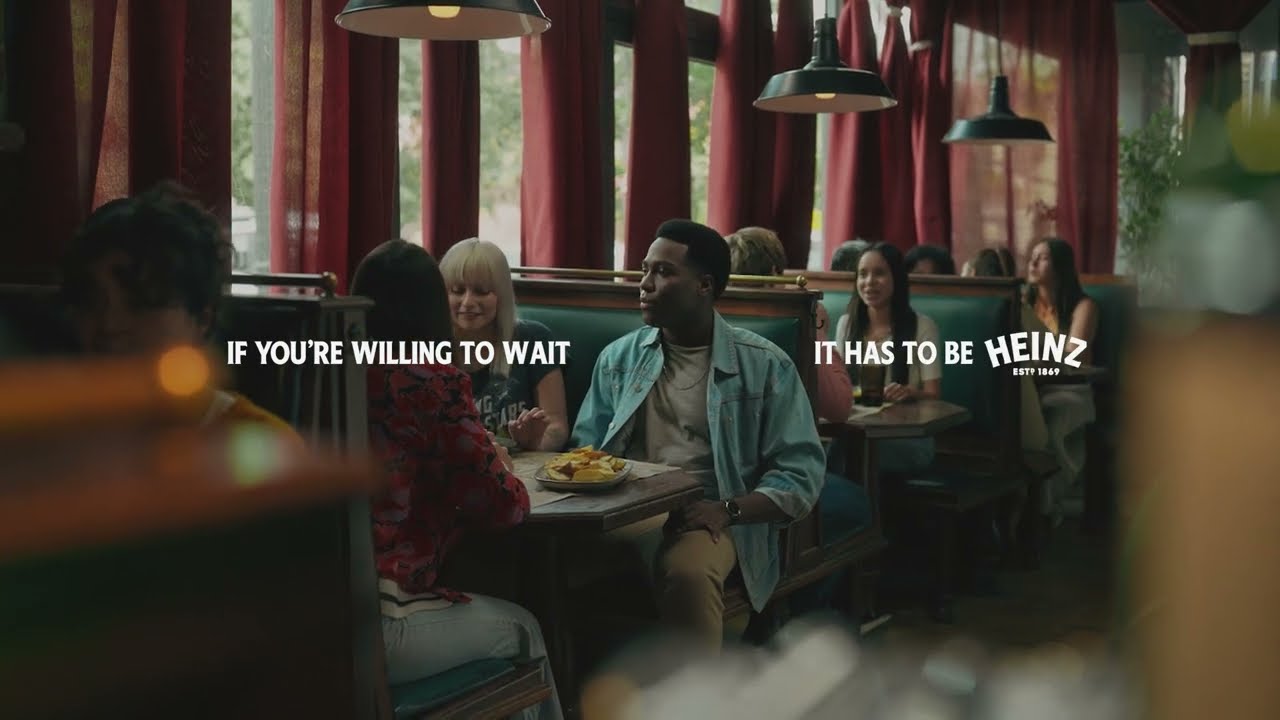
A man sits in a restaurant booth with a plate of chips in front of him and does not touch them. His friends eat; he waits. Fifteen seconds later the only thing that has happened is that a bottle of Heinz has not arrived, and that is the entire advert. Launched in January 2024 by the Chilean agency 1984, “The Wait” is the Heinz advert that made the ketchup the hero by leaving it out of the shot.
The one-line take: it is the sharpest expression yet of Heinz’s “irrational love” platform, and it proves that in a category built on product shots the boldest thing you can do is refuse to show the product.
Credits
Client: The Kraft Heinz Company (Thiago Rapp, head of Heinz comms and brand build, international; George Buneder, CMO, Hispanic markets)
Agency: 1984, Santiago, Chile
Creative leads: Felipe Mañalich (founder and chief creative officer), Diego Torres (creative director), Sebastián Elfelbein (copywriter), Felipe Alegría and María José Mansilla (art directors), Gabriel Jeffries (chief strategy officer)
Director: Santiago Correa
Production company: Fabula (Ismael Mora, executive producer)
Photographer (print): David Calderón
Media agency: Carat; PR: Zeno Group (North America)
Launched: 23 January 2024, in the US, Canada, UK, Chile, France, Brazil and the UAE
The brief: prove the love is irrational
Heinz unified its global advertising under one platform, “It Has to be Heinz”, in June 2023. The launch announcement called it the brand’s first global creative platform in more than 150 years, built with Wieden+Kennedy around five vignettes of real and could-be-true stories of people going to absurd lengths for the sauce. Every subsequent piece of Heinz work has had to answer one question: what would a person do for Heinz that they would not do for any other ketchup?
1984’s answer came from a survey. Heinz commissioned Toluna to poll 2,706 consumers worldwide and, as Marketing Dive reported, more than two-thirds said they would rather wait to eat than eat without ketchup, even if the food went cold. Fifty-five per cent said they would wait longer if the ketchup was Heinz, and nearly one in five Heinz loyalists said they would hold out for up to ten minutes. The strategy wrote itself: if you are willing to wait, it has to be Heinz.
The idea: the absent hero
The film
The hero spot is fifteen seconds long and contains no bottle. A diner sits with a full plate while the people around him eat, and the camera simply holds on him holding out. There is no voiceover explaining the joke, no clock in the corner, no reveal of a waiter with a bottle. The line at the end does the work: if you are willing to wait, it has to be Heinz.
George Buneder, Kraft Heinz’s CMO for Hispanic markets, put the thinking plainly when the campaign launched: the absence of the bottle is what makes the ad stand out, and it turns Heinz into “the absent hero” of its own story.
The print and the placements
The print work, shot by David Calderón, freezes the same moment: a laid table, an untouched plate, a person with their hands in their lap. The credits on Ads of the World list film, out-of-home and print, and the media plan is the cleverest part of the whole thing. Carat placed the contextual out-of-home in places where people were already waiting: office lobbies, lifts and street furniture, so the ad appeared at the exact moment its audience was living the insight.
In the UK, Campaign covered the launch in late January 2024; the same film and stills ran across all seven markets, a global campaign that needs no translation because it has almost no words.
The craft: direction, casting, restraint
Santiago Correa’s direction for Fabula is an exercise in doing nothing well. The comedy in a fifteen-second film about waiting lives entirely in the casting and the timing: the diner’s face has to read as patient rather than sulky, and the people eating around him have to look ordinary rather than cruel.
The writing is almost invisible, and that is the compliment. Sebastián Elfelbein’s end line carries the whole argument in ten words and never mentions taste, tomatoes or heritage. Calderón’s stills give the campaign a second life in print without needing a different idea, which is what a properly integrated concept looks like.
If there is a weakness it is scale. Fifteen seconds and a handful of stills is a small campaign for seven markets, and there is no longer cut that lets the tension build to something excruciating. The idea could have carried sixty seconds. Heinz chose not to find out.
Where it sits in Heinz’s run
“The Wait” is the fourth consecutive Heinz campaign to start from a piece of human behaviour rather than a product claim. “Draw Ketchup”, by Rethink Toronto in January 2021, asked people in 18 countries to draw ketchup and found they drew Heinz. “Tip for Heinz”, in November 2022, asked diners in restaurants without Heinz to leave an extra dollar on the bill marked for the brand, which offered to reimburse the tip. “Ketchup Fraud”, from March 2023, photographed restaurant staff refilling Heinz bottles with cheaper sauce and ran it as press and out-of-home in New York and Chicago, as Marketing Dive reported at the time.
Each of those works the same muscle: find a thing people already do for Heinz, and film it. The Absolut tie-up that VML branded Absolutely Heinz sits alongside them as the licensing expression of the same confidence. “The Wait” is the purest version because it removes the last crutch, the product itself, and trusts the behaviour to carry the brand.
The body of Rethink work that preceded it won the Creative Effectiveness Grand Prix at Cannes Lions 2024, with Heinz reporting 12 per cent global ketchup sales growth since 2019, 3.2 share points reclaimed from competitors and Kantar “Icon” status in 2023. That context matters when judging “The Wait”: it arrived on a platform that was already demonstrably moving numbers.
Why absence sells
Leaving the product out is not a stunt. It is a signal of category dominance. Only a brand that is already the default can afford to be recognised by the gap it leaves, and every second the viewer spends noticing there is no bottle is a second spent thinking about Heinz. Challenger brands cannot run this ad; the absence would read as an absence.
It also converts a research statistic into a feeling. “Two-thirds would wait” is a chart. A man ignoring his chips while his friends eat is a small act of love, and Mañalich framed it exactly that way at launch: in an era when everyone wants everything fast, waiting is the novelty.
The results: what is verified
Heinz has not published sales or brand-tracking numbers specific to “The Wait”, and this magazine does not invent them. What can be verified is recognition. The film won a Wood Pencil in Film at D&AD 2024 and a Bronze at the Clio Awards 2024 in the film category for spots of thirty seconds and under, both credited to 1984 with Fabula as production company.
Respectable rather than sweeping, and the honest reading is that the commercial verdict belongs to the platform, which was measurably working before “The Wait” and kept working after it.
What to steal
Start from a behaviour, not a benefit. Heinz found something people already do and filmed it. Ask what your customers put up with for you that they would not put up with for a rival.
Commission the number, then hide it. The Toluna survey shaped the idea and fed the PR, but the film never quotes a statistic. Research belongs in the press release, not the script.
If you are the default, try leaving yourself out. Absence only works for the leader, but if you are the leader it is the most confident thing you can do.
Buy media where the insight is happening. Lifts, lobbies and bus shelters turned a waiting ad into an ad about the viewer’s own wait.
Write an end line that needs no translation. Ten plain words carried seven markets without a local adaptation.
The verdict
Heinz “The Wait” scores 8 for idea, 8 for craft, 7 for bravery, 5 for effectiveness and 7 for legs. The idea is a single thought a stranger can repeat, and the craft is a masterclass in restraint from Correa and Fabula. Bravery is real, because removing the bottle takes a client with nerve, but it is bravery on a platform that already had proof of concept. Effectiveness is marked down for the absence of campaign-specific evidence, not for any suspicion that it failed. Legs is a seven because the wait can be filmed anywhere, in any culture, for years. It is the best ketchup advert in a decade of very good ketchup adverts, and the one most likely to be taught.
What to steal
Start from a behaviour, not a benefit
Commission the number, then keep it out of the script
If you are the category default, try leaving yourself out
Buy media where the insight is happening
Write an end line that needs no translation
Max Rottier
He plans, buys and reviews advertising for a living, and helps score campaigns on the site against the same five Crown Score criteria alongside other authors and contributors.
Kraft Heinz's growth chief Karen Owen reveals a 23 per cent year-on-year uplift in spaghetti hoops after a custom necklace for JoJo Siwa and Chris Hughes, plus new numbers for Heinz's bean pouches.
McCann Erickson took the Bisto Kids' hundred-year-old 'Aah' and turned it into a booked appointment. A review of the Bisto advert that sold an occasion, not gravy.
One photograph of Heinz Beanz on two biscuits, no paid media, a day of brand replies and a debate in the House of Commons. Frank PR's Beanz on Bix, reviewed.
The Ad Ranking letter
One verdict a week. No press releases.
The campaign worth studying, the ASA ruling worth knowing, and the number nobody else reported. Every Thursday.
One email a week. Unsubscribe in one click. We never share your address.