 63/100
Bisto ‘Aah Nights’: how a 1919 catchphrase became a night of the week
McCann Erickson took the Bisto Kids' hundred-year-old 'Aah' and turned it into a booked appointment. A review of the Bisto advert that sold an occasion, not gravy.

One repeatable thought executed with fanatical consistency: third to first at a 40 per cent price premium, in a market that was supposed to be immovable.
In March 2017 Yorkshire Tea was the third biggest standard black tea in Britain, on a volume share of 17.9 per cent against Tetley’s 22.2 and PG Tips’ 27.7. It sold at a price index of 140 against the market average, in a category shrinking by around 5 per cent a year, where 43 per cent of buyers stuck to one brand. Lucky Generals’ answer was to hire famous Yorkshire people to do menial jobs at the tea factory. Six years later the brand was number one and still charging the premium.
Our take: the most disciplined long-running platform in British advertising, and the best argument in the country for not changing your campaign.
Tea is the hardest kind of market to move: habitual, declining and inherited. The Effie Awards UK case sets out the arithmetic. Kantar found 43 per cent of British standard black tea buyers were single-brand loyal, against a 13 per cent average for fast-moving consumer goods, so growth could only come from prising people off brands their parents had bought.
Yorkshire Tea also had less equity to lean on than the incumbents. Tetley had the Tea Folk from 1973 and PG Tips had a monkey with a lineage back to the chimps of 1957. Yorkshire Tea’s spontaneous awareness was 48 per cent, against 62 for Tetley and 72 for PG Tips. The business objective was to reach number one on volume within five years without discounting to get there.
The agency’s insight came from the factory, where Yorkshire Tea taste-tests a thousand cups a day and brews with hard water brought in specially so the tea still works in Sheffield. Nobody wants that lecture. So instead of explaining the manufacturing, Lucky Generals decided to imply it: show a company that does every trivial job properly, and the drinker will assume the important job is done brilliantly.
That produced the endline “Where everything’s done proper” and a device that generates ads indefinitely. Hire a famous Yorkshire person, give them a small job at the tea company, and let the joke be the mismatch between the reputation and the task. Sir Michael Parkinson became head of interviews, the Brownlee brothers ran the courier round and Kaiser Chiefs played the hold music live in reception.
The casting is governed by written rules, which is why it has not drifted. The hires must be from Yorkshire, must be national treasures, and must be genuine experts at the thing they are being hired to do. A fourth rule was added after the 2019 round: they must be famous across generations. That rule exists because Sean Bean’s induction speech broke every tracking measure while Dynamo, levitating a bag of leaves in the warehouse, did not, for the simple reason that fewer people knew who he was.
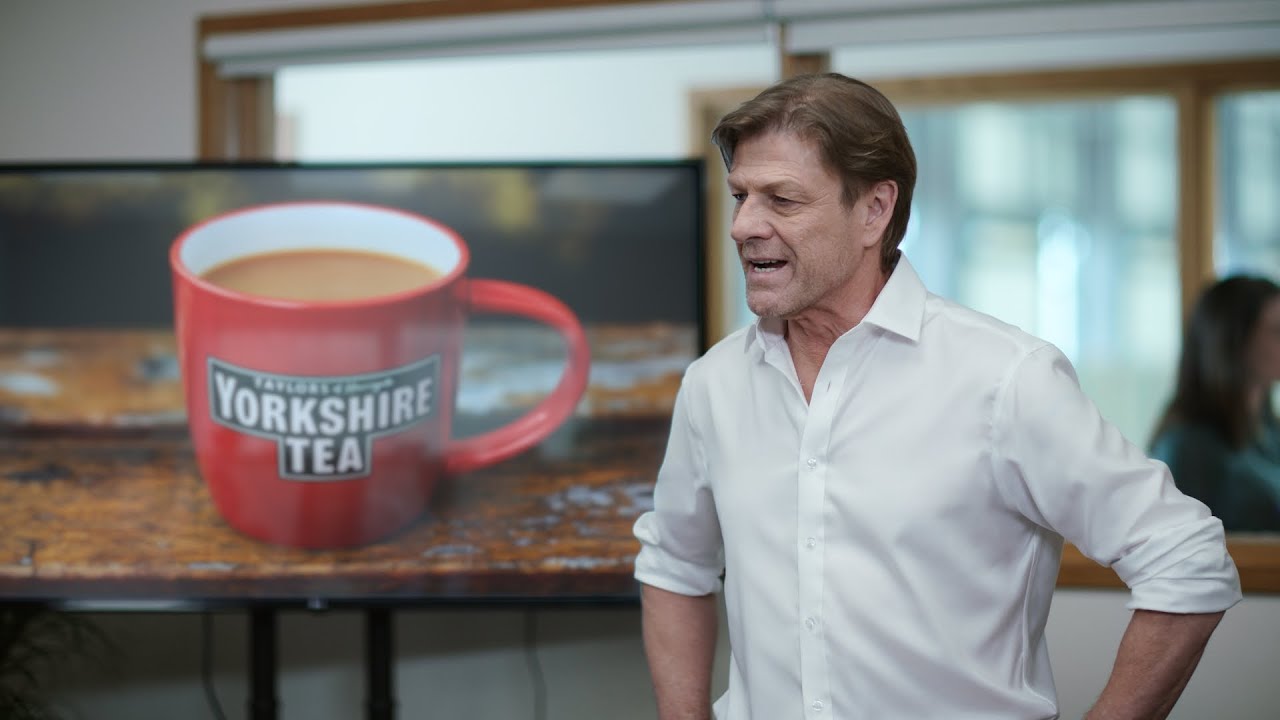
The Bean film is the template. He walks into a beige meeting room to run a staff induction, builds to a full Agincourt-grade rallying cry about doing it for Yorkshire, and then the energy is punctured by the room’s flat response. Martin Granger directed it through Moxie Pictures, and it launched on 1 July 2019 alongside the Dynamo spot. Both were shot at the company’s real Knaresborough offices and warehouse with actual employees in the room.
That last detail is the craft decision that carries the whole platform. Real staff, real building, real fluorescent lighting: the comedy only works if the setting is unglamorous enough to make the celebrity absurd. The tone is deadpan, the jokes are small, and nobody ever winks at the camera. Every film ends the same way, on the Yorkshire Tea HQ sign and the endline, which is why brand attribution has never been a problem.
“Proper” turned out to be a governing idea rather than a slogan, which is rarer than the industry pretends. In 2019 the brand announced carbon-neutral packs with a film in which the artist behind the pack illustration keeps adding environmental cues, decides it is “probably a bit much”, and sticks on a logo instead. That is a purpose message told as a joke against itself.
The tone held under pressure too. In early 2020, when some followers demanded the brand disown its support for Black Lives Matter, Yorkshire Tea replied “Please don’t buy our tea again”, and competitor brands tweeted #Solidaritea in support. When Rishi Sunak, then chancellor, posted himself next to a bag of it, the brand defused the partisanship row with a shrug rather than a statement. During lockdown it made Yorkshire Zoom backgrounds and a social distancing teapot with a six-foot spout.
The Effie case is unusually clean, because the product did not change and distribution stayed flat at around 95 per cent throughout. Volume share rose from 17.9 per cent in March 2017 to 26.3 per cent in early 2023, and Yorkshire Tea became Britain’s biggest-selling tea in early 2021, a year ahead of the five-year target. The premium held: a retail price per kilo index of 140 against the market average, maintained and slightly increased, while every rival cut price at some point.
The brand measures behind it moved in step. Spontaneous awareness went from 48 to 54 per cent while PG Tips fell from 72 to 64 and Tetley from 62 to 59. All four quality image statements rose by double digits, including “worth paying more for” at plus 10 per cent. Campaign recognition peaked at 67 per cent against a best competitor peak of 33, and attribution reached 85 per cent.
The media discipline is the underrated part. Lucky Generals kept the campaign on air in 46 of the 71 months after launch and held excess share of voice at around 60 per cent, roughly double the brand’s market share. Awards followed the numbers rather than the reel: Silver at the IPA Effectiveness Awards in 2018 for the early years, the Grand Effie at the Effie Awards UK 2023 for sustained success, and a Gold at the IPA Effectiveness Awards 2024 with Goodstuff for “Long-term brand building done proper”.
The platform is still generating work. Sir Patrick Stewart’s proper leaving speech extended it, and in January 2025 Sarah Lancashire arrived as a security investigator solving a brewdunnit involving missing biscuits and a vanished stapler, directed by Traktor through Stink Films with around twenty real Yorkshire Tea staff cast internally. The device has now absorbed a talk show host, two Olympians, a rock band, a magician, two knights of the realm and a detective drama, and it has not bent.
The risk is arithmetic rather than creative. The supply of nationally famous Yorkshire people who are also experts at a mundane job is finite, and each new hire has to clear four rules. The category is still shrinking, and the brand is now the one being attacked rather than the challenger doing the attacking.
Judged on the criteria in our scoring method, this is close to the ideal case: one repeatable thought, executed with almost fanatical consistency, in a market that was supposed to be immovable, with third-party evidence attached at every stage. It is not the most beautiful advertising in Britain and it was never trying to be. It took a distant third to number one at a 40 per cent price premium without changing the product, and there is no more useful campaign for a marketer to study.

He plans, buys and reviews advertising for a living, and helps score campaigns on the site against the same five Crown Score criteria alongside other authors and contributors.
63/100McCann Erickson took the Bisto Kids' hundred-year-old 'Aah' and turned it into a booked appointment. A review of the Bisto advert that sold an occasion, not gravy.
 73/100
One photograph of Heinz Beanz on two biscuits, no paid media, a day of brand replies and a debate in the House of Commons. Frank PR's Beanz on Bix, reviewed.
 79/100
BMP DDB gave the jokes to Rowan Atkinson and the product line to his assistant. Seventeen films, nine British Arrows, an IPA Gold and a cinema franchise later, a full review.