 63/100
Bisto ‘Aah Nights’: how a 1919 catchphrase became a night of the week
McCann Erickson took the Bisto Kids' hundred-year-old 'Aah' and turned it into a booked appointment. A review of the Bisto advert that sold an occasion, not gravy.
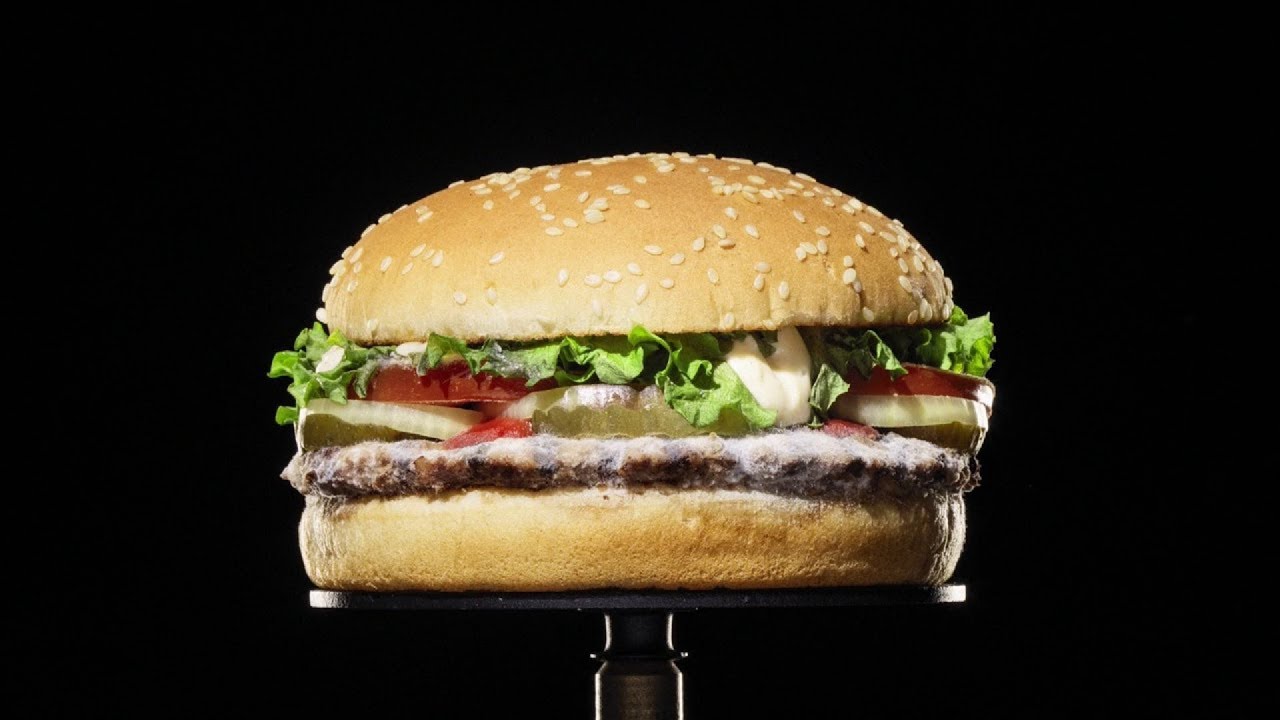

A perfect idea, beautifully made, that two independent testing houses found suppressed the desire to eat a burger, and Burger King has published nothing to counter them.
A Whopper is built on camera in the usual pornographic style, lit and stacked and glistening. Then nobody touches it for thirty-four days. By the end it is a blue-green fur ball, and the line reads “The beauty of no artificial preservatives”. Burger King released the Moldy Whopper on 19 February 2020, and no Burger King advert before or since has been argued about this hard.
The one-line take: it is the bravest food advertising of the century and one of the least persuasive, and both of those things are true at the same time.
Burger King had taken the artificial preservatives, colours and flavours out of the Whopper across most European markets and in 400 US restaurants, with a promise of nationwide rollout by the end of 2020. This is the hardest brief in food marketing: a genuine product change that is completely invisible to the customer, in a category where nobody believes a word anyone says about ingredients.
Worse, the category already had a piece of folklore working against it. Fast food burgers that fail to rot are a recurring internet story, and they are cited as proof that the food is not food. Fernando Machado’s team had to overturn a belief the brand itself had spent decades earning.
A conventional answer would have been a clean-label endframe on an appetite spot. It would also have been ignored, because a claim in a burger ad carries no evidential weight whatsoever.
Rot is the only credible evidence available. If the burger goes off, there are no preservatives in it, and no amount of consumer scepticism can argue with mould. That is a sharp thought and a stranger can repeat it in one line, which is the test.
Where it becomes a great idea rather than a clever one is the framing. The campaign does not apologise for the decay or treat it as a stunt. It photographs the mould as though it were a still life, and asserts that this is beauty, which forces the viewer to accept a whole new definition of what an appetising burger looks like.
The film runs forty-six seconds and is essentially one shot, a time lapse of thirty-four days on a plain background. Viktor Kumlin lights it as product photography throughout, so the frame never changes its opinion of the burger even as the burger changes completely. That consistency is the trick: the camera keeps treating it as food long after the audience has stopped.
The music does the heavy lifting. Dinah Washington’s 1959 recording of “What a Diff’rence a Day Makes” is a love song about transformation, played straight, with no wink. Pairing it with decay is the single best decision in the campaign, because sincerity is what stops the film reading as a gag.
The print and outdoor by Pål Allan, with Anna Lindblad styling, are arguably stronger than the film. A mouldy Whopper shot as a hero still, at poster scale, on a bus shelter, is a genuinely new image in a category that has used the same three lighting setups since 1970. The full credits run to three agencies on two continents, which tells you how much of the work was in the making rather than the thinking.
On trophies it is close to unbeatable. At D&AD in 2020 it took a Black Pencil in PR, the first Black Pencil ever awarded to an agency in Romania, and helped make DAVID Miami Advertising Agency of the Year and Burger King Client of the Year. It won Best of Show at the One Show the same year.
At Cannes in 2021 it took the Outdoor Grand Prix, plus a gold in Outdoor and a gold in Print & Publishing, entered by DAVID Miami, INGO Stockholm and Publicis Romania. Awards are a measure of craft and nerve, not of effect, and Burger King has never published an audited effectiveness case for the work.
What does exist is testing data, and it is not kind. Ace Metrix found the film scored 10 per cent above the quick service norm on attention but 36 per cent below the category benchmark on purchase desire, with 26 per cent of viewers saying it actively put them off buying. The message about preservatives was the single thing respondents liked most, which is the campaign’s defence and its problem in one sentence.
System1’s Test Your Ad panel gave it 1.0 star, the floor of the scale, with an extremely high Spike score for short-term salience. Tom Ewing’s reading is that the dominant emotion is disgust and that disgust attaches itself to the brand, not to the absent preservatives, so the film buys attention at the cost of the long-term associations that actually grow a burger business.
Independent pre-testing by Cubery found the same shape: roughly half of US viewers reported feeling disgusted, and the lasting impression was “gross” rather than “real”, with perceptions of taste and quality falling. Both houses agree the ad is memorable. Neither found evidence it makes anyone hungry.
The sharpest British verdict came from Campaign, which made it Turkey of the Week eight days after launch. Brittaney Kiefer’s objection was not squeamishness but motive.
Released just a few months before Cannes Lions, this reeks of awards bait.
Brittaney Kiefer, Campaign, 27 February 2020
The defence is that purchase desire was never the job. Burger King was not launching a limited edition, it was correcting a belief, and correcting a belief requires people to notice and to remember. A clean-label endframe scoring comfortably on appetite appeal and nothing on recall would have been a more expensive failure.
There is also a straightforward brand-fame argument. The film dominated a news cycle, was covered by NBC, TIME and CNN rather than only the trade press, and gave Burger King a piece of visual property that competitors cannot copy without looking derivative. For a challenger to McDonald’s, being the chain that is arguing about its own ingredients in public is not the worst place to stand.
The honest position sits between the two. The idea is unimprovable and the execution is beautiful, and the available evidence says it moved the wrong numbers. Both camps are looking at real data.
The Moldy Whopper closed a chapter rather than opening one. It is the most complete example of the Machado-era Burger King method, which used PR-shaped stunts to make a fast food brand behave like a challenger, and it turned out to be the point at which that method stopped being copyable. Nobody has repeated it, because there is only one first mouldy burger.
Its more useful legacy is as a case study in the limits of bravery. It sits in every list of the best advertising campaigns and in every effectiveness lecture as the counter-example, and being both is a rare kind of importance.
The Moldy Whopper is a perfect idea, beautifully made, that two independent testing houses found actively suppressed the desire to eat a burger, and Burger King has published nothing to counter them. It scores very high on idea, craft and bravery and low on effectiveness, and under our rubric an absent business case is a mark against the work, not an excuse for it. Steal the nerve, and then go and check whether anyone got hungry.

He plans, buys and reviews advertising for a living, and helps score campaigns on the site against the same five Crown Score criteria alongside other authors and contributors.
63/100McCann Erickson took the Bisto Kids' hundred-year-old 'Aah' and turned it into a booked appointment. A review of the Bisto advert that sold an occasion, not gravy.
 73/100
One photograph of Heinz Beanz on two biscuits, no paid media, a day of brand replies and a debate in the House of Commons. Frank PR's Beanz on Bix, reviewed.
 79/100
BMP DDB gave the jokes to Rowan Atkinson and the product line to his assistant. Seventeen films, nine British Arrows, an IPA Gold and a cinema franchise later, a full review.