The 20 best Apple adverts ever made, ranked
Twenty Apple films ranked, from a 1985 Super Bowl failure to a 2024 apology, with 1984, Think Different and Get a Mac at the top and the agency, year and director checked for each.

A launch film with no product in it, forced onto air over its own board's objections, that beat its hundred-day sales target by 44 per cent and then never aired again.
Apple’s board of directors watched “1984” in December 1983 and hated it. John Sculley got cold feet and instructed Chiat/Day to sell the Super Bowl time back. Steve Wozniak offered to pay for half of the slot out of his own pocket if Steve Jobs covered the rest. The agency sold thirty seconds of the ninety it had booked, then reported that it could not shift the remaining sixty, which was not true because it never tried.
Our take: the most consequential sixty seconds in advertising history, and the one that would fail almost every modern pre-test, approval process and brand-safety review it was put through.
The Macintosh was a $2,495 machine from a company that IBM was in the process of squeezing out of the business market. Jobs framed the stakes plainly in his 1983 keynote, telling dealers that IBM wanted it all and had aimed its guns at the last obstacle to industry control. The commercial grew out of an abandoned print campaign whose theme was that monster computers in big business and big government knew everything about you, and that Apple was trying to balance the scales by handing individuals the computing power once reserved for corporations. That is the whole strategy, and it never appears on screen.
Lee Clow has been careful about the reading ever since. The original concept was not “IBM is Big Brother”, it was the fight for control of computing as a struggle of the few against the many, with the Mac as the tool of empowerment. The distinction matters because it is why the ad still works: it is not an attack on a competitor, it is a position on what technology is for. Attack ads date within a quarter, and positions do not.
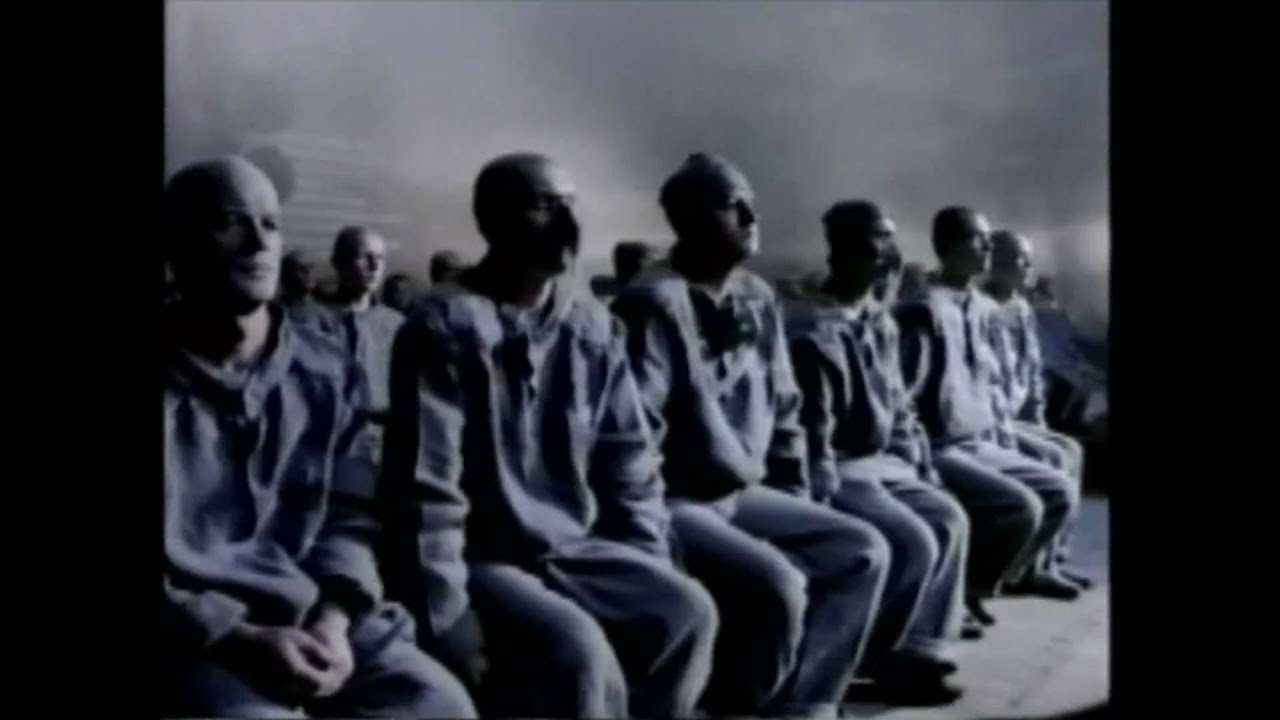
Steve Hayden wrote it, Brent Thomas art directed it and Lee Clow ran it. The film shows no computer. It shows rows of shaven-headed drones in a grey hall, a talking head on a screen, a woman in red shorts running in with a sledgehammer, and an explosion of light, and then it hands you a single line of copy and a logo. The only mention of the product is that endline, which promises that on 24 January Apple will introduce Macintosh, and that you will see why 1984 will not be like 1984.
Withholding the product is the bravest choice in the ad, braver than the Orwell reference. A launch commercial that does not show the thing being launched is asking the audience to want an idea first and a box second, which is the trade Apple has been running ever since.
Agency producer Richard O’Neill hired Ridley Scott, eighteen months after Blade Runner, and Scott shot it in England. Adrian Biddle, who would later shoot Aliens and Thelma & Louise, lit it in the smoke-and-shafts idiom Scott had already made his own, and Pamela Power cut it so that the drones’ procession is all stasis and the runner is all movement. The extras were paid $25 a day. Scott has since said he used local skinheads for the pale drones and put the total cost at less than $250,000, although The New York Times reported at the time that he filmed it in England for about $370,000.
The runner is Anya Major, an English athlete, actress and model born in 1960. Most of the models and actresses who tested could not handle the sledgehammer convincingly, and Major won the part because she could. It is a casting decision that reads as a craft decision: the hammer swing has to be believable in a single wide shot with no cut to hide behind. Major later played the title role in the video for Elton John’s “Nikita” in 1985.
David Graham, the English actor best known at home as Parker in Thunderbirds and one of the original Dalek voices, supplies Big Brother’s monologue about the Unification of Thoughts. The mix keeps him boomy and slightly degraded, as if heard through a public address system, so that the only clean sounds in the film are boots, breathing and the hammer. Edward Grover reads the endline. There is no music until the screen goes white, which is a discipline almost nobody attempts in a launch spot.
We also set out to smash the old canard that the computer will enslave us. We did not say the computer will set us free. I have no idea how it will work out. This was strictly a marketing position.
Brent Thomas, art director, The New York Times, March 1984
“1984” ran nationally once. Chiat/Day had already slipped it out on 31 December 1983 on KMVT in Twin Falls, Idaho, in the last break before midnight, purely so that it qualified for the 1984 Clio Awards. The national airing came in the third quarter of CBS’s coverage of Super Bowl XVIII on 22 January 1984, a game the Los Angeles Raiders won 38 to 9 in front of an estimated 77.62 million American viewers. News programmes rebroadcast it that night, which is the point: the paid media was one slot and the earned media was a fortnight.
On the commercial side, Brent Thomas told The New York Times that about $3.5 million worth of Macintoshes sold in the period just after the ad ran, and judged the effort absolutely successful. Jobs had predicted 50,000 units in the first hundred days. Apple passed that by 6 April and had sold 72,000 by day one hundred on 3 May 1984, with product marketing manager Barbara Koalkin telling USA Today that Apple could have sold 200,000 if it had been able to build them. That is a supply problem, not a demand problem, which is the outcome every launch brief secretly asks for.
The industry verdict arrived fast and never really moved. It took a Clio in 1984 and the Grand Prix at Cannes the same year, then Advertising Age‘s Commercial of the Decade, its Greatest Commercial ranking in 1995, and the top slot in TV Guide‘s greatest commercials list in 1999. It is worth noting the one legal wrinkle: in April 1984 the George Orwell estate and the television rights holder to the novel sent Apple and Chiat/Day a cease-and-desist letter alleging copyright infringement.
Before “1984”, Super Bowl advertising was expensive television. After it, the Super Bowl break became a genre with its own budgets, its own directors and its own press cycle, and every advertiser in that break is still working inside a format Chiat/Day invented by accident. Apple has returned to the well repeatedly, including a 2004 reissue with an iPod digitally added to the runner. The ad has never been broadcast again in its original form, which is a large part of why it retains its charge.
It belongs in the small group of ads that sold a worldview rather than a feature, alongside Volkswagen’s “Think Small” two decades earlier. Both had to be forced past nervous clients, and both are now taught as though they were obvious. Rebecca Solnit, writing in Harper’s thirty years on, offered the necessary corrective, arguing that the industry the runner liberated went on to concentrate wealth and disperse attention. A great ad can be right about its moment and wrong about the future.
“1984” earns its status on idea and bravery, which are close to unimprovable: a computer launch with no computer in it, made by a company that could not afford to be wrong, screened over the objections of its own board. Craft is very high rather than perfect, because the film leans on Blade Runner‘s vocabulary as heavily as any homage in the archive. Effectiveness is strong but soft-edged, resting on a contemporaneous $3.5 million figure and a hundred-day sales run that beat its target by 44 per cent, with no published econometrics behind it. Legs is where it scores badly and honestly, because it aired once and can never air again, and our reasoning on all five measures is set out in how we score and applied across the best advertising campaigns.

He plans, buys and reviews advertising for a living, and helps score campaigns on the site against the same five Crown Score criteria alongside other authors and contributors.
Twenty Apple films ranked, from a 1985 Super Bowl failure to a 2024 apology, with 1984, Think Different and Get a Mac at the top and the agency, year and director checked for each.
 73/100
One photograph of Heinz Beanz on two biscuits, no paid media, a day of brand replies and a debate in the House of Commons. Frank PR's Beanz on Bix, reviewed.
 79/100
BMP DDB gave the jokes to Rowan Atkinson and the product line to his assistant. Seventeen films, nine British Arrows, an IPA Gold and a cinema franchise later, a full review.