 63/100
Bisto ‘Aah Nights’: how a 1919 catchphrase became a night of the week
McCann Erickson took the Bisto Kids' hundred-year-old 'Aah' and turned it into a booked appointment. A review of the Bisto advert that sold an occasion, not gravy.
Betty White in the mud, an IPA Gold and 15.9% global sales growth. We review the Snickers platform that turned one repeatable sentence into sixteen years of measurable fame.
83/100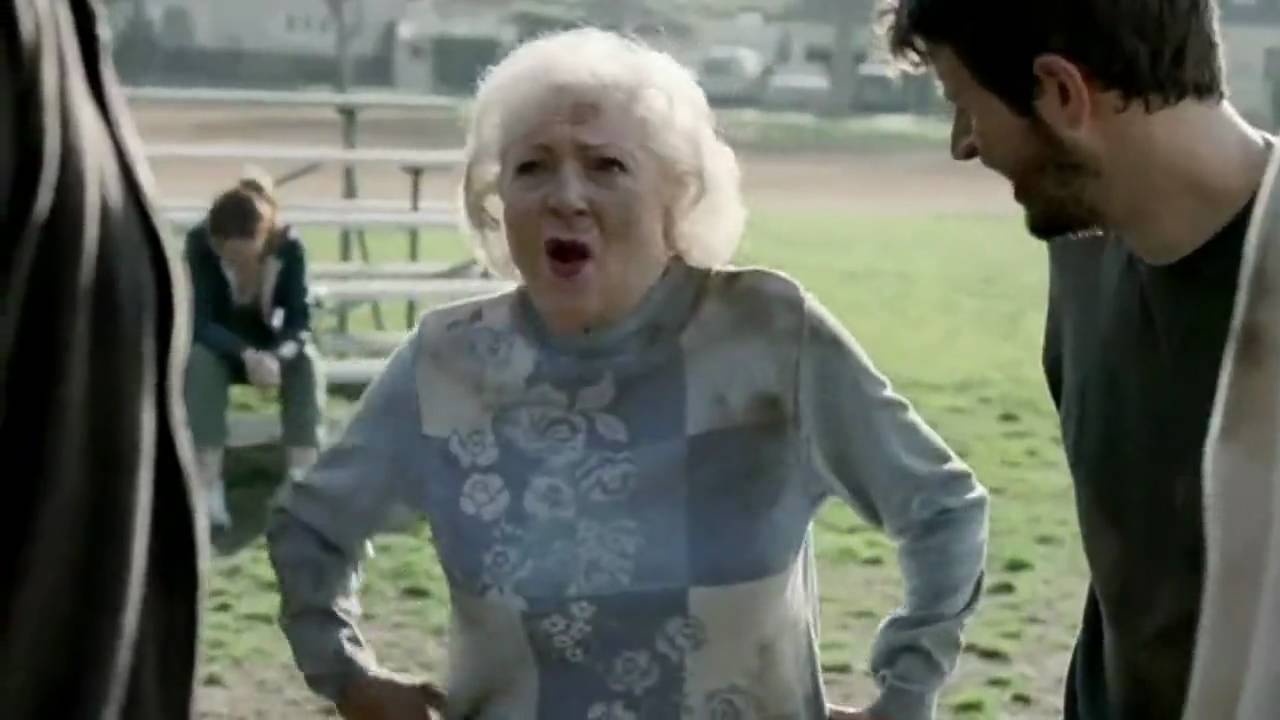

A single repeatable sentence engineered from day one to be measured, and the rare canonical campaign whose growth numbers have been judged in public rather than merely asserted.
Betty White, then 88 years old, gets driven face first into the mud during a scratch game of American football. That is how Snickers opened what has become the best documented advertising platform of the past twenty years, in Super Bowl XLIV on 7 February 2010. The line at the end, “You’re not you when you’re hungry”, went on to run in 58 markets. It is the rare famous campaign that arrives with the paperwork.
Our take: one sentence a stranger can repeat, built from the first day to be measured, and still earning its keep sixteen years later.
Between 2007 and 2009, Snickers grew more slowly than the other global chocolate brands, in both relative and absolute terms. It was gaining volume and losing share, and projections showed it would eventually surrender its position as the world’s leading chocolate bar. The diagnosis, set out by BBDO’s global head of strategy for Mars, James Miller, in his case study for Campaign, was blunt. The work had become too niche.
The underlying number was worse than the share data. Up to 2010, half of everyone who bought a Snickers in a given year did not buy one the next. Snickers had to replace half its buyer base annually simply to stand still. That is not a loyalty problem, it is a memory problem.
Mars was an early adopter of Byron Sharp and the Ehrenberg-Bass Institute, and the strategy leans on that reading openly: memories are fragile, brands are substitutable, penetration is king. In an impulse category where a shopper faces ten to a hundred options at the fixture, the brand that gets picked is the one that comes to mind first. So the brief was not awareness, which an 80-year-old brand already had in abundance. The brief was fame.
The creative shift was from a young male audience to everybody, without abandoning the brand’s male tone of voice. Qualitative work found a code of conduct that men follow to stay part of the pack, recognisable to men and legible to everyone else. Hunger breaks the code. You become cranky, weak or dopey, you stop being yourself, and a bar with substance in it puts you back.
We need to be more like Knocked Up and less like Jackass.
David Lubars, BBDO global chief creative officer, quoted in Campaign
The mechanic that came out of it is almost embarrassingly simple. Cast a famous person as the visible symptom of someone else’s hunger, put them in a situation of male camaraderie, then swap them back when the bar is eaten. It is a body-swap comedy compressed into thirty seconds, and it is endlessly recastable. Mars is a decentralised business, so the platform was deliberately built to be handed to local markets rather than dubbed at them.
The launch film, “Game”, was written and art directed by Peter Kain and Gianfranco Arena at BBDO New York, directed by Craig Gillespie through MJZ and shot by Emmanuel Lubezki, according to the credits published by Communication Arts. Having a cinematographer of that calibre on a thirty second gag is not vanity: the mud, the low winter light and the physical comedy all need to read instantly. Betty White takes a genuine tackle and lands flat. Then Abe Vigoda takes one.
The writing is doing more work than it looks. The insult that triggers the joke, “you’re playing like Betty White out there”, is answered by White with “that’s not what your girlfriend said”, which flips the target of the mockery inside two seconds. The product then does something, rather than merely appearing. Compare it to Cadbury’s Gorilla, which bought fame with pure mood and no product logic at all, and you can see why Snickers has been able to run its device thousands of times and Gorilla could not.
Most canonical campaigns are canonical on vibes. This one is not. “Game” topped USA Today’s poll of that year’s Super Bowl advertising and generated 400 million incremental unpaid media impressions, a media value of $28.6m and 11.4 times the initial investment, from a single thirty second spot that produced 91 days of coverage. Betty White played the ad on Leno, Oprah, Larry King and Ellen, and the resulting online petition put her on Saturday Night Live.
The commercial evidence is stronger still. Two years after launch, with 58 markets representing 88.7% of global sales running the platform, Snickers was growing at 15.9%, or 9.4 times its growth rate before the campaign. Share grew in 56 of those 58 markets. Sales rose by $376m across 2010 to 2012.
Those figures are not agency arithmetic. They were submitted, judged and published: the campaign took a Gold at the 2012 IPA Effectiveness Awards in the Best International category, under the IPA’s own case study record, and Abbott Mead Vickers BBDO also won a Creative Effectiveness Lion at Cannes that June. There is a softer internal metric worth noting too. Eighteen months in, 93% of Mars marketing directors said Snickers had real momentum, against 43% before launch.
Russia, the second largest Snickers market, adopted the platform early with the ballerina Anastasia Volochkova playing basketball, and the first film earned four times the media placements of the previous campaign. China generated more than $1.1m in earned media for a brand that had barely registered in the local press. Australia’s “Aussie builders” film from Clemenger BBDO produced more than 238 million global media impressions in a fortnight. The device travels because the joke is in the casting, and every market has its own famous faces.
The UK came late and arrived sideways. Five celebrities, including Katie Price and Rio Ferdinand, posted four wildly out-of-character tweets each before a fifth revealed the Snickers bar. Twenty-five tweets reached more than 26 million people and prompted a question in the House of Commons three days later. It also produced the ASA’s first ruling on a Twitter campaign in March 2012, which dismissed the complaints on the basis that the combination of the #spon tag, the brand handle and the product shot made the commercial intent clear enough.
Bravery is the low score here, because a comedy platform for a chocolate bar risks very little beyond the media invoice, and some of the later executions are lazy retreads of a device that was sharper in 2010. Everything else is close to the ceiling. The idea is a single repeatable sentence, the launch film is properly directed rather than merely shot, the effectiveness case is published and independently judged, and the thing has now run for sixteen years across television, print, social, outdoor and retail without breaking. If you want to know how our scoring works, this is roughly what a nine out of ten for effectiveness looks like in practice, and it earns its place near the top of our best campaigns ranking.

He plans, buys and reviews advertising for a living, and helps score campaigns on the site against the same five Crown Score criteria alongside other authors and contributors.
63/100McCann Erickson took the Bisto Kids' hundred-year-old 'Aah' and turned it into a booked appointment. A review of the Bisto advert that sold an occasion, not gravy.
 73/100
One photograph of Heinz Beanz on two biscuits, no paid media, a day of brand replies and a debate in the House of Commons. Frank PR's Beanz on Bix, reviewed.
 79/100
BMP DDB gave the jokes to Rowan Atkinson and the product line to his assistant. Seventeen films, nine British Arrows, an IPA Gold and a cinema franchise later, a full review.