 63/100
Bisto ‘Aah Nights’: how a 1919 catchphrase became a night of the week
McCann Erickson took the Bisto Kids' hundred-year-old 'Aah' and turned it into a booked appointment. A review of the Bisto advert that sold an occasion, not gravy.

A blunt, genuinely risky idea executed with total conviction, which grew a drifting bar 28.7 per cent while its biggest rival shrank, and which scores badly only on longevity because provocation has no second act.
On Easter Monday 2002 Nestlé put a red line through half the population and sold a great deal more chocolate. The Yorkie logo was redrawn so the “O” became a woman inside a no-entry sign, the wrapper read “It’s not for girls”, and the posters ran lines like “Not available in pink”. Twelve months later Nielsen had the brand up 28.7 per cent in a category growing at two. Our take: a crude idea executed with total conviction, and the clearest proof in British confectionery that exclusion sells to the excluding.
Yorkie was born male. Eric Nicoli at Rowntree’s spotted a gap in 1976 for a chunkier, blunter answer to Cadbury Dairy Milk, and the launch advertising built the brand around a lorry driver who ate one at the wheel. The trucker ran from 1976 until 1992, sixteen years of consistent iconography, and then he was retired.
What followed was silence. By early 2002 the brand had not had a proper advertising campaign for six years, and it was drifting in a singles market where every rival was selling indulgence, softness and pleasure. Nestlé needed a relaunch that would reconnect the bar to the only audience it had ever spoken to.
Andrew Harrison, then marketing director, framed the brief as cultural rather than commercial. He told The Guardian that most men felt the world was changing around them and that it had become less acceptable to have anything that was only for males. Yorkie, he said, was starting the reclaiming process.
The insight underneath “It’s not for girls” is a real one about how identity brands work. A product that everybody is welcome to belongs to nobody in particular, and confectionery had spent three decades making everything feel like a bubble bath. Yorkie’s answer was to declare a membership rule, then police it in every medium.
What lifts it above a stunt is the discipline of the execution. The no-women device went on the pack, not just the poster, so the joke was in the customer’s hand at the till rather than only on air. That is the difference between a campaign and a positioning.
The poster and press lines did the heavy lifting. “Don’t feed the birds”, “Not available in pink” and “King size not queen size” ran at launch, and a later 48-sheet added “Girls, save your money for driving lessons”. Each is a one-line sketch that could be read at 40 miles an hour, and each is deliberately calibrated to be repeated by the target and complained about by everyone else.
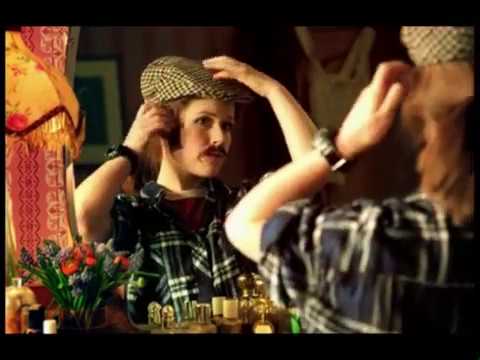
The best-known film has a woman disguising herself as a man to buy a bar, in a fake moustache and builders’ clothes, having memorised the offside rule. She fails the last test and is refused. It is short, broad and shot like a sitcom cold open.
Judged as film-making it is unremarkable, and that is a fair criticism of the campaign. The craft here is not in the direction but in the identity design and the copywriting, which is why the posters have outlived the commercials in the public memory. The redrawn logo is the single best piece of work in the whole campaign, because it turns a strapline into a road sign.
The media planning deserves credit too. Year two ran across 48-sheet static and mobile billboards, washroom advertising, beer mats and covermounts on FHM and Loaded, all environments where the audience was already alone or in male company. The medium was doing the targeting that the message was only pretending to do.
The campaign attracted trouble almost immediately, which was clearly the intention. A sampling exercise that handed free bars to men only was blocked by Liverpool and Birmingham councils, and the BBC reported in April 2002 that a promotional worker had been attacked by an angry shopper.
The posters drew 97 complaints to the Advertising Standards Authority on the grounds that they reinforced sexist attitudes towards women. In May 2003 the ASA ruled that the complaints were not justified, as Marketing Week reported at the time. A separate print execution in FHM headlined “Size matters” was also cleared.
That regulatory outcome matters more than it looks. The campaign was engineered to sit just inside the line, generating the free coverage of a ban without ever earning one. Ninety-seven complaints is a large number for a chocolate bar and a small number for a national outrage, which is roughly where the strategy wanted to land.
The numbers are unusually clean because there was a controlled experiment running alongside. Masterfoods relaunched Mars in the same year with a £7.5m spend aimed at attracting more women, so the market had two big confectionery relaunches pulling in opposite directions.
Nielsen data for the 52 weeks ending 22 February 2003 put Yorkie up 28.7 per cent and Mars down 5.4 per cent, against a singles category growing at two per cent. Yorkie achieved that on well under half the media weight of the campaign it beat.
We all try to think of ideas to boost brands, but it’s very rare we get growth on this scale.
Liam Newton, head of brand marketing, Nestlé, in Marketing Week, April 2003
There is no published IPA Effectiveness paper on the campaign, so the Nielsen year is the strongest evidence available and there is nothing in the public record on how the growth held up after year two. That is a real gap, and it caps the effectiveness score. Our marking method is set out in how we score.
The line lasted a decade, but the advertising did not. After the initial burst Yorkie went ten years without a television campaign, which tells you the brand had stopped investing in the idea long before it disowned it. The joke had become a wrapper, and a wrapper cannot generate news.
In June 2012 Nestlé moved on. Campaign reported that a new JWT London television ad, its first in ten years, rolled out on 4 June under the tagline “Man Fuel for Man Stuff”, with men treated as superheroes for carrying the shopping in one trip. Business Insider records that the “It’s not for girls” line and the no-women sign came off the packaging in the same period.
Nestlé never issued a mea culpa, and the replacement line kept the same territory with the aggression sanded off. The most plausible reading is commercial rather than moral: an idea whose entire fuel was provocation had become simply familiar, and the cultural weather that made it funny in 2002 had turned. The brand had already blunted its own rule in 2006 by putting out a limited pink edition marketed to women, which is what happens when a joke becomes a range extension.
The man who commissioned it has since been blunt about whether it could run again. Andrew Harrison, by then long gone from Nestlé, told the Telegraph in an interview reported in June 2026 that the answer was “absolutely not”, and that Britain had moved in a generation “from blokey humour to wokey correctness”. He added that in 2002 the team assumed everyone had a sense of humour, which is a fair description of the bet the campaign made.
The campaign now functions mostly as a periodic social media artefact, resurfacing every couple of years to be re-litigated by people who were not the target. For a more considered example of a confectionery brand buying attention rather than borrowing offence, see our review of Cadbury’s Gorilla, and for where both sit in the wider canon, our ranking of the best advertising campaigns.
Judged on the job it was hired to do, this is one of the most efficient relaunches in British confectionery: 28.7 per cent growth against a category at two, achieved on a smaller budget than the rival campaign it beat. Judged as work it is thin, with a fine piece of identity design and a set of poster lines carrying some very ordinary films. It scores well on bravery and badly on legs, because an idea whose only engine is provocation has no second act, and Yorkie spent ten years proving it.

He plans, buys and reviews advertising for a living, and helps score campaigns on the site against the same five Crown Score criteria alongside other authors and contributors.
63/100McCann Erickson took the Bisto Kids' hundred-year-old 'Aah' and turned it into a booked appointment. A review of the Bisto advert that sold an occasion, not gravy.
 73/100
One photograph of Heinz Beanz on two biscuits, no paid media, a day of brand replies and a debate in the House of Commons. Frank PR's Beanz on Bix, reviewed.
 79/100
BMP DDB gave the jokes to Rowan Atkinson and the product line to his assistant. Seventeen films, nine British Arrows, an IPA Gold and a cinema franchise later, a full review.