The best Halloween adverts ever made, ranked
Twelve Halloween adverts ranked on idea, craft, bravery and evidence, from Burger King's Scary Clown Night and Tesco's Spookermarket to Heinz Tomato Blood, with verified credits.
Fifteen beer adverts ranked on idea, craft, bravery and evidence, from Heineken's Refreshes the Parts and Carling's Dambusters to Dos Equis and Corona, with verified credits.
Beer has no functional story to tell. One lager is much like another, the price gap is small, and nobody buys a pint because of a product demonstration. That vacuum is why the best beer adverts are so often the funniest and the most stylish work of their decade: with nothing to say about the liquid, the category was forced to become entertainment, and it got very good at it.
This is Ad Ranking’s list of the fifteen best beer adverts ever made. We have judged them on the same four questions we apply to everything: is there one idea a stranger could retell, does the craft survive a second viewing, did the brand risk anything, and is there published evidence it worked. Agency, year and creative credits have been verified for every entry, and where a credit could not be stood up it has been left out rather than guessed.
Five giants are missing on purpose, because each already has its own review on this site: Guinness, Budweiser’s Whassup, Boddingtons and John Smith’s, plus Stella Artois. Take them as read. What follows is everything else.
We Believers turned a beach brand’s biggest liability into its media buy. Mexican fishing communities were invited to compete on the weight of plastic they hauled out of the sea rather than the weight of fish, then connected to recycling companies so the plastic kept paying them after the tournament ended. It won Gold Lions at Cannes in Sustainable Development Goals, Brand Experience and Activation, and Outdoor, and the programme now runs in ten countries after removing more than twenty tonnes of plastic. Most sustainability advertising is a film about a promise; this is a mechanism. Crown verdict: the rare green idea that is an operating model rather than a mood film.
Ogilvy and Mather’s answer to a French lager brewed for Britain was to make celebrities of the Alsace hop farmers, with Eric Cantona narrating their arrival like a transfer announcement. It is a joke about provenance told with an entirely straight face. The ASA banned it in February 2014 for implying more about the beer’s French credentials than the facts supported, then the ruling was overturned on appeal that June. Few campaigns are good enough to survive being ruled against and still be remembered fondly. Crown verdict: a category cliché, provenance, played so deadpan that it becomes a genuine idea.
Brad and Dan sit on a jetty in Queensland taking video calls from British men with problems no adult should need help with. Adam&eveDDB built it as a service, not a story: an ongoing agony uncle format that could absorb any social insight the brand wanted to sell that month, always closing on “good call”. Foster’s dropped it in May 2015 in a move away from laddish advertising, then brought it back in April 2019 with a six million pound spend, which tells you how little it found to replace it. Crown verdict: a format rather than a film, and formats are what beer brands actually need.
Publicis Italy and Edelman London staged a real job interview for a real Heineken vacancy, then made the interview itself unusual enough to film: candidates found themselves holding the interviewer’s hand, dragging him out on a stretcher, and being asked to react rather than recite. The output is closer to hidden-camera documentary than advertising, and it hired someone. It took a Gold Lion in PR at Cannes in 2013 plus two Silvers in Promo and Activation, part of a haul of nine prizes in the festival’s first three days. Crown verdict: employer branding smuggled into the beer aisle, and better cast than most drama.
Gold Greenlees Trott dropped Griff Rhys Jones into black and white Hollywood, so that he played opposite Marilyn Monroe and John Wayne in their own films, decades before anyone called it deepfaking. The technique was the joke and the joke was the product benefit: this lager makes you the leading man. It was voted 54th in Channel 4’s 100 Greatest TV Ads in 2000, which undersells how technically ambitious it was for the era. Crown verdict: the smartest use of archive footage British advertising has managed, and still funnier than most of what it inspired.
Allied-Lyons launched Castlemaine XXXX in Britain in May 1984 with a line that got a swear word past the regulator by refusing to say it, and then spent a decade filming Australians treating good manners as a medical condition. The 1986 execution, titled Sherry, was voted 25th in Channel 4’s 2000 poll. Its trick is that the brand is never the butt of the joke and never the hero either. No agency credit for the UK campaign could be verified. Crown verdict: the best-executed piece of national caricature in lager advertising, and the cleanest bit of censor-dodging.
Droga5 New York could not afford the four and a half million dollars a Super Bowl slot cost, so it advertised the advert it would have made if it could. There were teasers for a film that did not exist, interviews with the stars who were not in it, focus groups reacting to a fake trailer, and finally a storyboard version of party sharks and battle apes released while the real ads aired. It generated over a billion impressions and made almost every Super Bowl top ten without ever airing in the game. Crown verdict: the sharpest piece of advertising about advertising ever sold to a client.
A man called Joe stands in front of a cinema screen and quietly explains that he does not live in an igloo and does not say “aboot”. Bensimon Byrne’s Glen Hunt wrote it, Kevin Donovan directed it and Jeff Douglas performed it, and by the end the volume and the nationalism have both climbed several notches. It premiered in March 2000 and the text was later anthologised in a Penguin collection of Canadian poems and songs. No sales figures were ever published, which is the only reason it is not higher. Crown verdict: sixty seconds that a country adopted as an unofficial anthem, written to sell lager.
BMP gave a mediocre lager a bear in a yellow jacket, and George became one of the few drinks mascots British audiences could impersonate on demand. The work is pure attitude: the bear is cooler than the humans, the humans know it, and the beer is what he drinks. Channel 4’s 2000 poll placed it 58th, and the brand’s 2023 relaunch with BBH brought George back rather than trying anything new, which is its own verdict. The performer inside the suit has never been reliably identified. Crown verdict: proof that a character can outlive the product it was hired to sell.
DDB Chicago launched twelve radio spots saluting the inventor of the foot-long hot dog and his peers, with Survivor’s Dave Bickler howling the tributes over Pete Stacker’s straight-faced announcements. It began as Real American Heroes, was pulled after 11 September 2001 because mocking heroism had stopped being funny, and returned in 2002 under the name everyone now remembers. It won the Cannes Radio Grand Prix in both 2005 and 2006 and a Grand Clio in 2003. Radio is the format most brands treat as a tax, and this one turned it into a decade-long comedy series. Crown verdict: the best radio advertising any beer brand has ever made, by a distance.
Euro RSCG gave a small Mexican import a spokesman who barely endorses it. Jonathan Goldsmith, silver-bearded and surrounded by admirers, is described by Will Lyman’s voiceover in a stream of absurd feats before conceding: “I don’t always drink beer, but when I do, I prefer Dos Equis.” The genius is the hedge. A category built on absolute claims found a character whose only claim is a preference, and the internet turned the construction into a meme template within a year. Goldsmith stepped down in March 2016, a French replacement lasted two years, and the brand brought him back in January 2026. Crown verdict: the most quotable endline in modern beer advertising, and the most copied.
Tony Bodinetz wrote the line at KMP in 1973, and the single word “probably” did more for Carlsberg than any amount of certainty could have. It is a superiority claim that cannot be challenged, a piece of British understatement sold back to Britain by a Danish brewer, and from 1983 it arrived in Orson Welles’s voice, reused for years afterwards. Carlsberg retired it in 2011 and spent the next decade discovering what it had thrown away. The 2019 relaunch, Fold7’s “probably not the best beer in the world”, read out real complaints from social media and worked precisely because the original was still in everyone’s head. Crown verdict: the most valuable adverb in advertising.
Light beer barely existed as a category until McCann-Erickson filled a bar with retired American footballers, boxers and a baseball umpire and had them argue about which half of the proposition mattered more. Bubba Smith, Ray Nitschke, Joe Frazier, Rodney Dangerfield and Mickey Spillane all took a side, and the row itself became the format. Every low-calorie product since works from this template: never apologise for the compromise, dramatise it. Crown verdict: the campaign that invented an entire beer segment, and never once said the word “diet”.
The commercial evidence is unusually clean. Light beer was a negligible share of the American market before 1973 and accounted for 44 per cent of it by 2002, and Ad Age ranks the campaign the eighth greatest in advertising history.
WCRS took the 1955 war film, put Mark Arden and Steve Frost in the Lancaster, and gave the Germans a goalkeeper. As the bouncing bombs skip down the reservoir, a lone sentry tips, palms and catches them away one by one, until a watching comrade delivers the campaign line: I bet he drinks Carling Black Label. It is an England versus Germany penalty shoot-out hidden inside a war picture, and it lands in under thirty seconds without a word of setup.
Roger Woodburn directed it through Park Village, and the flying footage was shot with the seriousness of the film it parodies, which is why the gag survives repetition. Channel 4’s 2000 poll placed it 17th and ITV’s 2005 viewer vote put it 12th. Crown verdict: the best-constructed joke in British beer advertising, and the only parody that improves on the original’s most famous scene.
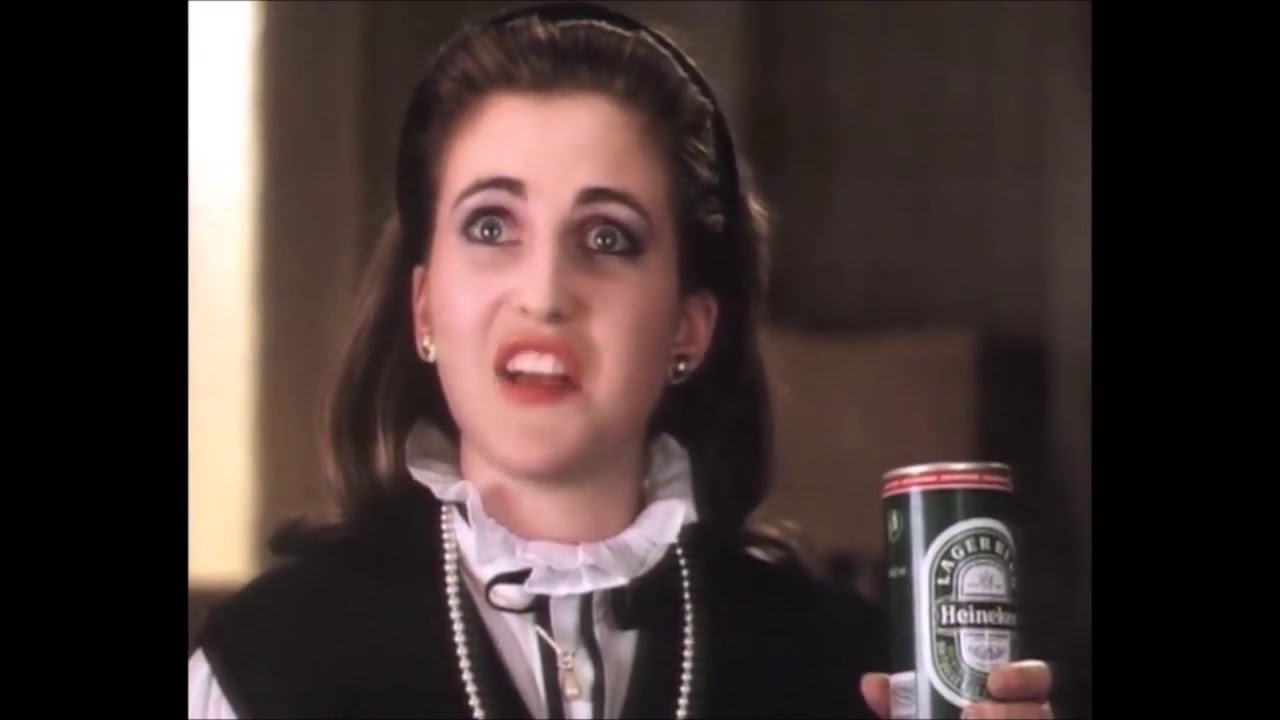
Collett Dickenson Pearce received a brief consisting of one word, refreshment. Copywriter Terry Lovelock and art director Vernon Howe got nowhere with it for weeks, until Lovelock woke at three in the morning in a Marrakech hotel with the line and two scripts. Refreshes the parts other beers cannot reach is a functional claim written as a joke, which is why it could run for three decades and carry any story you attached to it: policemen’s feet, a drama student’s vowels.
The best-known execution is Water in Majorca, voted 29th in Channel 4’s 2000 poll, in which a student cannot get her mouth round the sentence until the lager arrives. The campaign won a D&AD Black Pencil for best television campaign in 1975, an award given out sparingly enough that most years there is none. The line then did the thing every copywriter wants and almost none achieve: it left advertising and entered ordinary speech, borrowed by journalists, politicians and, in the early 1990s, the Prince of Wales. Crown verdict: the most useful sentence ever written for a beer, and the only one that still works as a punchline fifty years on.
Four tests, applied in the order we apply them to every campaign we score. Idea comes first: can a stranger retell it in a sentence. Craft second: does the direction, casting and sound still hold up when you already know the joke. Bravery third: did the brand risk money, taste or a regulator’s attention. Effectiveness last, and only on published evidence, which is why Miller Lite outranks work that is funnier and why The Rant, magnificent as it is, sits at eight.
Longevity is the tiebreak. A beer campaign that runs for fifteen years has solved a harder problem than one perfect film, because the category gives you nothing new to say and expects you to keep saying it. That is why two of the top four are lines rather than executions. Credits were checked individually and anything unverifiable was omitted, which is why some entries name a director and others do not.

He plans, buys and reviews advertising for a living, and helps score campaigns on the site against the same five Crown Score criteria alongside other authors and contributors.
Twelve Halloween adverts ranked on idea, craft, bravery and evidence, from Burger King's Scary Clown Night and Tesco's Spookermarket to Heinz Tomato Blood, with verified credits.
Twenty food adverts ranked on idea, craft, bravery and evidence, from the Gold Blend couple and Coca-Cola's Hilltop to Jaffa Cakes, PG Tips and Maltesers, with verified credits.
From a Fiat built by robots to a Honda diesel engine chased out of a rainbow: twenty car adverts ranked on idea, craft, bravery, published effectiveness and legs.