The best Halloween adverts ever made, ranked
Twelve Halloween adverts ranked on idea, craft, bravery and evidence, from Burger King's Scary Clown Night and Tesco's Spookermarket to Heinz Tomato Blood, with verified credits.
Twenty-five commercials that still get a laugh, from John West's bear fight and Tango's Orange Man to Old Spice, Whassup and Dollar Shave Club, ranked with the agencies and the evidence.
The funniest advert ever made is John West’s “Bear” from 2000, ninety seconds in which a fisherman and a grizzly settle the ownership of a salmon with a kung fu fight, a kick in the groin and a distracting point at the sky. It is not the cleverest joke on this list, and it may be the best told. Ad Ranking’s list of the funniest adverts leans British, because Britain has spent fifty years treating the commercial break as a comedy slot, with room for the Americans who changed how everyone wrote.
The rule for entry is simple: the ad has to be funny now, to someone who was not there the first time. Nostalgia is not a joke. After that we apply the usual tests: idea, craft, bravery, evidence and staying power. Sixteen of the twenty-five have full reviews on this site and are linked, and where a credit could not be verified it has been left out.
The line has carried two decades of one-joke films, and the best of them is the sheepdog: champion shearer Arthur Arthurson works down the line of his flock and, without breaking rhythm, shears the collie. It sits on Specsavers’ own channel under the title “Collywobble”. Our review of the campaign covers the two IPA golds, and the line blames the viewer’s eyes, never the price, which is why it lasted. Crown verdict: the most repeatable joke structure in British advertising, and the dog is its finest hour.
Wieden+Kennedy London put a Shetland pony on a Scottish hillside and had it moonwalk to Fleetwood Mac’s Everywhere, then built a website so the public could make their own. There is no product message beyond “silly stuff”, which was the strategy. We reviewed it as the ad that sold a network by selling nothing, and everything in it is a set-up for one moonwalk, and the moonwalk delivers. Crown verdict: the purest example of a brand deciding that being laughed with is a positioning.
A man muses on what would happen if cats grew opposable thumbs, and Wieden+Kennedy shows us: a gang of them in the street, one flexing a knuckle, all of them coming for the milk. Bertrum Thumbcat became a minor celebrity and the film made a commodity brand into a talking point. Our review has the effectiveness story, and the taste claim is in there too, which is why it sold. Crown verdict: the best British example of taking a small absurd premise entirely seriously.
Doyle Dane Bernbach’s film is an advert about the making of an advert: actor Jack Somack must eat a meatball and say “Mamma mia, that’s a spicy meatball” on every take, and the takes keep failing until his stomach gives up. Howard Zieff directed. The joke is that we watch a man being destroyed by repetition, which is also what advertising does to lines. Crown verdict: the first great commercial about commercials, and still the template for every blooper-reel spot since.
Collett Dickenson Pearce paired a sitcom actor and a Hollywood star and, in every film, arranged for her to end up wearing the drink: the airline seat that reclines at the wrong moment is the one people remember. Rossiter’s oblivious bonhomie carries it. The trouble, often repeated, is that viewers remembered the spill and forgot the brand, which is why it sits here rather than higher. Crown verdict: the funniest running gag of the 1970s, and a warning about what a running gag costs.
Rawson Marshall Thurber wrote and directed, Lester Speight played the linebacker, and the premise was complete in one line: what if the company hired a football player to enforce office etiquette. Tate flattens a man for leaving the coffee pot empty, screams about cover sheets and reduces a whole floor to obedience. It ran in Super Bowl XXXVII and the longer films lived online when that was still new, passed around by email first. Crown verdict: the best violence-as-punctuation joke in American advertising.
Dancer Fitzgerald Sample and director Joe Sedelmaier gave an 81-year-old manicurist, Clara Peller, an enormous bun with a tiny patty and three words to say about it. The line went into a presidential primary within weeks. Wendy’s marked its fortieth anniversary with the original film, which still gets a laugh on the first “Where’s the beef?” and a bigger one on the third, and the claim about patty size was real. Crown verdict: the most quoted product comparison ever written, delivered by the least likely spokeswoman.
A small Darth Vader, played by six-year-old Max Page, tries to use the Force on the dog, the washing machine and his sandwich, and finally succeeds on the Passat, thanks to a father with a remote starter. Deutsch LA made it, Lance Acord directed, and the decision to release it online before the Super Bowl brought eight million views before broadcast. It placed third on USA Today’s Ad Meter and was the most viewed Super Bowl ad for years afterwards. Crown verdict: the joke that taught Super Bowl advertisers to launch on a Wednesday.
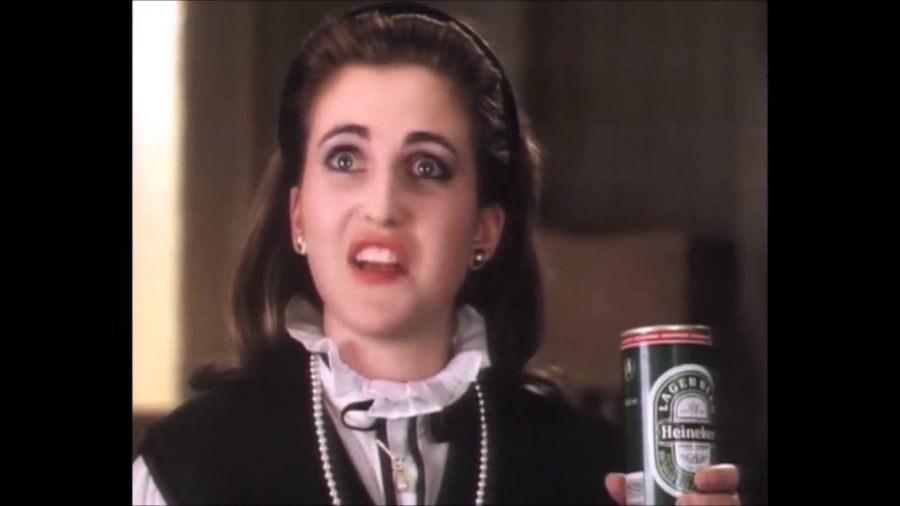
Terry Lovelock’s line “refreshes the parts other beers cannot reach” began at Collett Dickenson Pearce in 1974, and the best film it produced inverted My Fair Lady: a cut-glass Sloane is coached, unsuccessfully, to say “the water in Majorca don’t taste like what it oughta” until one Heineken releases her inner cockney. The construction is perfect because the beer does the same job in every execution and never the same way. Crown verdict: the wittiest idea in British beer advertising, in its funniest costume.
Bartle Bogle Hegarty shot a bitter as if it were a Chanel campaign and then let a Mancunian voice puncture every frame, a woman in an evening gown eating an ice cream cone made of beer and asking “by ‘eck, you smell gorgeous tonight, Petal”. The joke is the collision of registers, and it made a regional brewery national. Our review follows the campaign past the brewery’s closure, and Melanie Sykes joined later without the joke slipping. Crown verdict: the best parody of advertising ever run as advertising.
VCCP’s Aleksandr Orlov, a Russian meerkat aristocrat exasperated that people looking for cheap insurance keep landing on his website, was born from a 5p search keyword and became a category leader’s most valuable asset. The first film is still the tightest: one grievance, one catchphrase, one baffled stare. Our review has the numbers, and the toys and cinema deals came later; the joke came first, and it is still why people know the name. Crown verdict: the funniest thing ever to come out of a media plan.
Fallon baked a full-size Fabia out of sponge, marzipan and jelly to Julie Andrews’s My Favourite Things, and the punchline is the disclaimer: the car is “full of lovely stuff”, so the ad refused to show the real one. It is gentle rather than laugh-out-loud, which is why it sits mid-table, but the idea of demonstrating a car’s ingredients by making it edible is the kind of joke that only a confident brand tells. We reviewed it. Crown verdict: the sweetest joke on the list, and the only one you could eat.
TBWAMedia Arts Lab and director Phil Morrison put Justin Long and John Hodgman on a white cyclorama as Mac and PC and ran the double act for three years, a sitcom in thirty-second episodes. Britain got its own version with Mitchell and Webb, which is the only time a global campaign has been recast for a nation’s comedy taste. The jokes were small and the product claims were exact, a combination almost nobody manages. Crown verdict: the best character comedy ever built from a spec sheet.
TBWALondon gave Peter Kay a Sunday-league pitch, a teammate’s instruction to “keep it on the deck” and the chance to hoof a ball into the next county while shouting “‘ave it”. The No Nonsense campaign gave Britain two catchphrases in one summer, the second being the diving board’s “top bombing”. Our review has the whole run; the dive is a belly flop, and funnier for Kay’s total conviction. Crown verdict: the last time a beer advert put a phrase into every playground in the country.
HHCL’s spokesman Ray Gardner reads a complaint from a French exchange student, strips to his boxer shorts and marches through the building, across the car park and onto the cliffs at Dover to challenge Sebastien to a fight, in one unbroken shot with Harrier jump jets overhead. The escalation is the joke and the single take is the craft, and it gets funnier the longer it goes on. We reviewed it. Crown verdict: the most ambitious piece of comic staging in British advertising.
BBDO New York opened You’re Not You When You’re Hungry by tackling an 88-year-old Betty White into a puddle during a park football game, and a bar of chocolate turned her back into a young man. The casting did the work: it was the first Super Bowl ad in years whose joke was a person rather than a stunt, and Abe Vigoda took the second tackle. Our review covers how the platform travelled. Crown verdict: the best comic premise in confectionery, launched with its best gag.
Founder Michael Dubin walked through a warehouse in a single take, deadpanning about razors, a toddler with a razor and a bear called Alejandra, in a ninety-second film posted on 6 March 2012. It prompted 12,000 orders in two days and Unilever bought the company for a billion dollars in 2016. It is the funniest thing ever made for a business that did not yet exist, and its tone became the house style of a decade of start-ups. Crown verdict: the founder video every start-up has copied and none has bettered.
Fallon’s Juan Cabral filmed a gorilla waiting, breathing, flexing and finally playing the drum fill from Phil Collins’s In the Air Tonight, and sold no chocolate on screen at all. The laugh arrives at the fill and grows every time you watch the build, because the build is the joke. In 2026 the British public voted it their favourite commercial of the last fifty years with 26 per cent of the vote, and our review explains why it worked. Crown verdict: the only advert whose joke is anticipation itself.
WCRS’s I Bet He Drinks Carling Black Label series produced its masterpiece when a German sentry on the Möhne dam, hearing the Lancasters approach, calmly saves each bouncing bomb like a goalkeeper, and the British crew concede the point with the line. It parodies a national myth without a trace of malice, which is why it aged so well. The format, a feat and a bystander’s line, had never been used better. Crown verdict: the best sight gag in British advertising, timed to a drum roll.
Collett Dickenson Pearce’s Happiness Is a Cigar Called Hamlet ran for a quarter of a century, and the definitive film is Gregor Fisher’s comb-over losing to a photo booth: three flashes, three disasters, one cigar, Bach’s Air on the G String. There is no dialogue and no need for any, and Fisher’s face on the last flash is the whole campaign. Our review follows the campaign through the tobacco ban that ended it. Crown verdict: the most economical joke on this list, and the most human.
DDB Chicago bought Charles Stone III’s short film about four friends shouting a greeting down the phone and barely changed it, which is the point: it is a joke about how men say nothing to each other and mean everything. It won the Cannes Grand Prix and became the first advertising catchphrase to belong to the internet. Our review covers the short and the sequels. Crown verdict: the funniest thing ever said in a beer advert, and it was one word.
Boase Massimi Pollitt’s tin robots howl with laughter at earthlings who peel potatoes, boil them for twenty minutes and then “smash them all to bits”, which is a strategy document performed as comedy. The Martians laughed at the competition on the customer’s behalf, and instant mash stopped being embarrassing. We called it the funniest strategy ever put on British television, and stand by it. Crown verdict: the joke that made a product’s biggest weakness, that it was fake, into the reason to buy it.
HHCL’s fat orange man in a loincloth sprints across a park to slap a Tango drinker round both ears, replayed by two football pundits with a telestrator, and “You’ve been Tango’d” entered the language within a week. It was pulled after playground copycats and remade with a kiss, which made it more famous. Our review has the full story of the withdrawal. Crown verdict: the most anarchic advert ever put on British television, and the funniest use of a slow-motion replay.
Wieden+Kennedy Portland’s Tom Kuntz shot Isaiah Mustafa in one continuous take from bathroom to boat to horse, with every transition done live on set, and the writing keeps pace with the trick: “Look at your man, now back to me.” The response videos that followed, made in real time for commenters, turned a commercial into a week of television. It won the Cannes Film Grand Prix and an Emmy in 2010, and our review covers both films and the follow-up. Crown verdict: the best-written and best-built comic advert of the internet age.
Leo Burnett London and director Daniel Kleinman sent a man in a fishing hat to fight a grizzly for a salmon on an Alaskan riverbank, and every beat lands: the wildlife-documentary opening, the bear’s kung fu, the “Look, an eagle”, the kick between the legs, the walk away with the fish. It was passed around as an email attachment years before YouTube existed. Our review traces that journey. Crown verdict: the funniest advert ever made, because it is a perfect ninety-second film that also happens to be about tinned fish.
Barry Scott shouting about Cillit Bang and Gio Compario singing for GoCompare are two of the most effective campaigns on this site, and both are funny only in the way a car alarm is funny. They belong in our list of the most annoying adverts ever made, which explains why the irritation worked.
Every entry was scored on the idea, the craft, bravery, verified evidence of effect and staying power, with one test that overrides all of them: it had to get a laugh from someone watching it cold in 2026. That is why a 1974 robot outranks a Super Bowl film with sixty million views. Numbers are used only where the brand, its agency or a named research firm published them, and the list is revisited whenever something new makes the room go quiet and then loud.
John West’s “Bear” from 2000, directed by Daniel Kleinman for Leo Burnett London. Old Spice’s The Man Your Man Could Smell Like is the closest challenger.
Sixteen of the twenty-five entries are British, led by John West, then Tango’s Orange Man and Smash’s Martians. Cadbury’s Gorilla won the public vote at the 2026 British Arrows.
The ones here did: Dollar Shave Club took 12,000 orders in two days and BBDO says Snickers went from seventh to first in its category. Humour earns attention and affection, and both are measurable.

He plans, buys and reviews advertising for a living, and helps score campaigns on the site against the same five Crown Score criteria alongside other authors and contributors.
Twelve Halloween adverts ranked on idea, craft, bravery and evidence, from Burger King's Scary Clown Night and Tesco's Spookermarket to Heinz Tomato Blood, with verified credits.
Twenty food adverts ranked on idea, craft, bravery and evidence, from the Gold Blend couple and Coca-Cola's Hilltop to Jaffa Cakes, PG Tips and Maltesers, with verified credits.
Fifteen beer adverts ranked on idea, craft, bravery and evidence, from Heineken's Refreshes the Parts and Carling's Dambusters to Dos Equis and Corona, with verified credits.